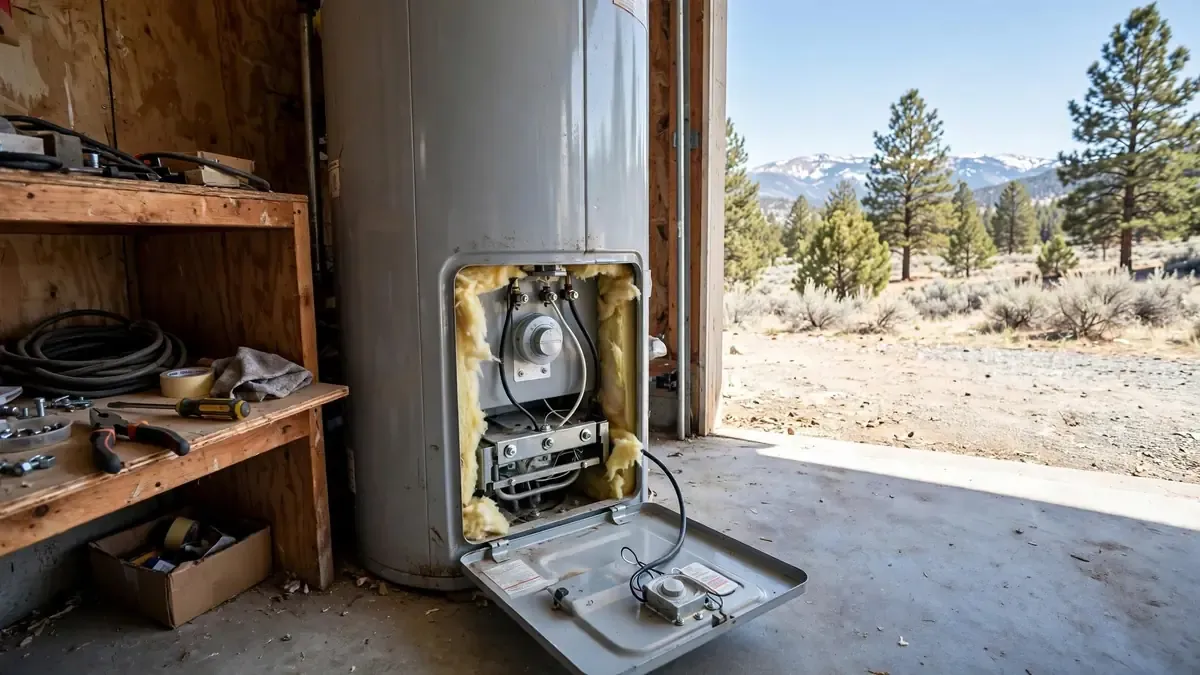
Water heater repair in Englewood, NJ covers any fix that gets a tank or tankless unit heating safely again, from a failed element to a leaking valve. If the tank is leaking, turn off the cold water supply valve on top of the heater and shut off its power or gas control per the maker's label. We run 24/7 emergency dispatch and offer same-day appointments when available.
Not every cold shower means a dead heater. A tripped breaker, a pilot that went out or a heating element that burned out can each be fixed for much less than a new unit. A water heater that is leaking from the tank itself is different, since a corroded steel shell cannot be patched.
Below you will find what each symptom usually means, how electric, gas and hybrid heaters fail differently, what to check before you call, and the point where repair stops making sense and water heater replacement makes more sense.
No hot water, lukewarm water or a puddle: what each usually means
No hot water at all is most often a power or fuel problem. An electric heater with a tripped breaker or a failed high-limit switch heats nothing. A gas heater with a blown-out pilot or a dirty burner does the same. These repairs are typically smaller than people fear.
Lukewarm water that runs out fast points to a failed lower element on an electric tank, or sediment piled up at the bottom of a gas tank so the flame cannot reach the water. Water that is too hot, or a heater that pops and rumbles, points to scale in the tank or a faulty thermostat.
A puddle needs closer reading. Water at a pipe fitting, a drain valve or the temperature and pressure relief valve can be repaired. Water seeping from the tank body, or the base of the heater, usually means the steel shell has rusted through.
Symptom, likely cause and usual repair
Use this to understand what the plumber is likely to find. The final call comes after testing the unit.
| Symptom | Likely cause | Usual repair |
|---|---|---|
| No hot water, electric tank | Tripped breaker, failed element or thermostat, tripped high-limit | Test and replace the failed element or thermostat |
| No hot water, gas tank | Pilot out, dirty burner, failed thermocouple or gas control valve | Clean and relight, replace the failed part |
| Hot water runs out quickly | Failed lower element or heavy sediment | Replace element or flush the tank |
| Drip at the relief valve discharge pipe | Valve worn, or pressure rising in the plumbing | Replace the valve and check the pressure and expansion tank |
| Water around the base | Fitting or drain valve leak, or a failed tank | Tighten or replace fitting. Replace unit if the tank leaks |
| Rotten egg or metallic smell in hot water | Bacteria reacting with the anode rod | Flush the tank and swap the anode rod |
| Banging or rumbling noises | Scale and sediment baked onto the bottom | Flush, or replace if the tank is worn |
Gas smell is never a repair question. Leave the building and call the gas utility or 911 first.
Leaking tank or flooding basement: what to do first
A water heater that is actively leaking can drop gallons onto a basement floor in short order, and the water often sits near a furnace, a panel or a washer. Treat it as an emergency, and call the 24/7 line even at night.
Same-day service is our aim for leaking tanks, and a plumber can often isolate the heater and decide on site whether a repair or a swap is realistic. The heater is rarely worth saving once the tank body is leaking.
- Close the cold water shutoff valve above the heater, or the main shutoff if the valve is stuck.
- Turn off an electric heater at its breaker. For gas, set the control to pilot per the manufacturer's label, and do not touch the gas line.
- Stay out of a flooded basement if outlets or a panel are underwater.
- Move boxes and valuables off the floor, and take photos for your insurer.
Electric, gas and hybrid heat pump heaters: what fails on each
Electric tank heaters use two heating elements and two thermostats. The upper element heats the top of the tank first, and the lower one does most of the work. When one fails the tank still produces some hot water, which is why a failure can hide for weeks before anyone notices.
Gas heaters rely on a pilot or electronic igniter, a thermocouple or flame sensor, a gas control valve and a flue that carries combustion gases out. Soot, a draft problem or a blocked flue can all shut the unit down. Flue problems can release carbon monoxide, so any scorch marks or soot near the draft hood need a licensed plumber and a working CO alarm.
Hybrid heat pump heaters pair a compressor and fan with backup elements. They fail like a small air conditioner would: a clogged air filter, a stuck fan, a blocked condensate drain, or a sensor fault. Parts are more specialised, and a plumber will check the manufacturer's code list before ordering.
Tankless units, briefly
Tankless heaters fail for different reasons, mostly scale in the heat exchanger, a clogged inlet screen or a blocked vent. Those have their own page, with a section on flushing and a note on repair, so start with tankless water heater service if yours has no tank.
Quick checks before you call
These take a few minutes and are safe for most homeowners.
- Check whether the breaker for an electric heater has tripped.
- Look for a lit pilot or a display code on a gas heater, and follow the label if the maker allows relighting.
- Find the temperature setting. A dial left on low or vacation mode is a common cause.
- Look at the floor and fittings for wet spots, and note exactly where water appears.
- Write down the model, serial number and age from the rating plate.
- Note any smell of gas, burning or rotten eggs. Gas means leave first and call 911 or the gas utility.
What affects the price of water heater repair
A repair bill follows the failed part and the work needed to reach it, not the size of the heater alone.
A thermostat or igniter is a simpler part than a gas control valve or a heat pump compressor.
Parts for current models are easy to find. Discontinued units can mean a longer search or a poor value repair.
A heater in an open basement is quicker than one in a tight closet or attic.
A rusty or leaking tank changes the question from repair to replacement.
After-hours calls cost more than daytime appointments. The price is clear before work starts.
Sudden water damage from a burst tank may be covered under some homeowners policies, but wear, rust and slow leaks are usually excluded. Ask your carrier before you assume either way.
Call for a clear price on your repair, and have the model number from the rating plate ready.
Hot water in Englewood basements and older homes
Englewood has about 11,563 housing units, and a city whose rail station opened in 1859 likely has plenty of older houses. In many of them the water heater sits in a basement with a floor drain nearby, which helps if a tank leaks. Each house must be checked on its own, so ask the plumber where a leak would go before you decide where to put anything fragile.
Much of northern Bergen County drinks water from Veolia's Oradell Reservoir system, so check the supplier named on your water bill, and ask that supplier for its annual water quality report. Sediment and scale vary by supply, and they affect how often a tank needs flushing and how long its heating parts last. Permit rules vary by job, so ask the Englewood Building and Code Enforcement office if a repair involves moving gas or vent piping.
Sometimes a repair is not worth it, and a water heater replacement is the better choice, especially if the tank itself is leaking. If you want to compare, tankless water heaters are the other option. Homeowners in Englewood Cliffs can call the same line.
Check a plumber before you hire
New Jersey law says plumbing work must be done by a licensed master plumber. Ask for the licence number, then confirm it with the State Board of Examiners of Master Plumbers, part of the New Jersey Division of Consumer Affairs.
Permit rules vary by job, so ask the Englewood Building & Code Enforcement office before work begins.
Water Heater Repair questions in Englewood
Yes. Our dispatch line is open 24/7 and same-day appointments are offered when available. A leaking tank or a gas smell is urgent at any hour. For a gas smell, leave the building and call the gas utility or 911 before you call us.
On an electric tank, the usual causes are a failed element, a bad thermostat or a tripped high-limit switch. On a gas tank, look for a pilot that went out or a failed thermocouple. A plumber tests each part with a meter instead of guessing.
No. Water from a fitting, drain valve or the relief valve can often be fixed. A leak from the tank body means the steel has corroded through, and that cannot be repaired safely.
Only if the label on your heater explains how and you smell no gas. If the pilot keeps going out, a thermocouple, draft problem or gas valve is likely at fault, and that needs a licensed plumber.
It needs airflow, a clean filter and a condensate drain that is not blocked. Many models also display error codes that point to specific faults, which a plumber can read before touching anything.
Many tank heaters last roughly 8 to 12 years, depending on water quality and care. Past that range, a second repair or any tank leak usually tips the decision toward replacement.
A drip at a fitting can wait for an appointment if you close the heater's cold water valve and catch the drip. Water pooling under the tank should stop at the main shutoff until a plumber arrives.
Still not sure what you need? Call the line and describe what you see.