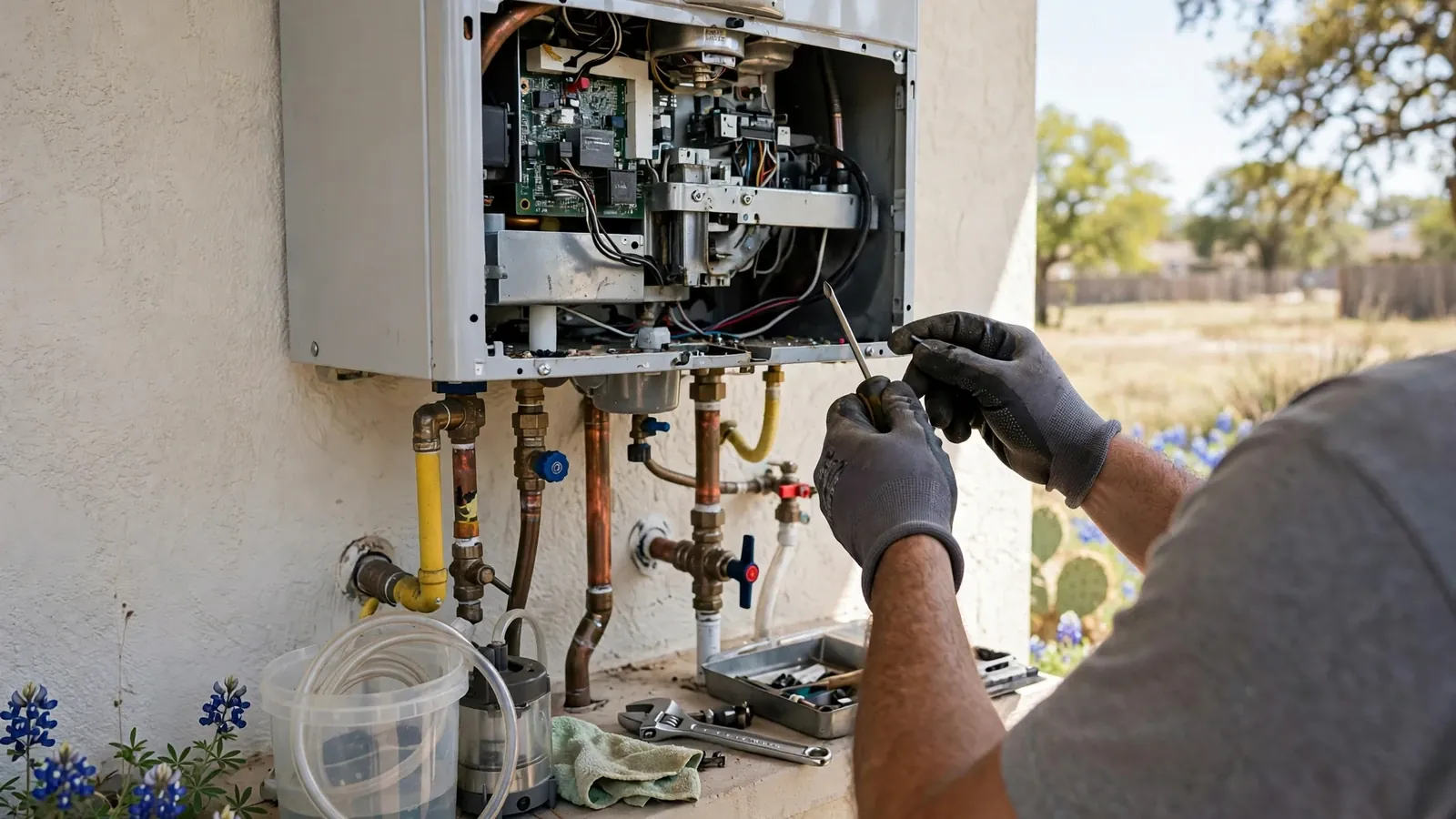
A tankless water heater in Englewood, NJ is a wall-mounted unit that heats water only when a tap opens, so it has no storage tank to leak or run dry. Plumbers install, repair and flush these units, and the work differs from a tank heater in ways that matter.
The appeal is endless hot water and a small footprint. The catch is that the unit must be sized to the flow you need at once, and it often asks for a larger gas line, heavier electrical service or new venting. A good install starts with those questions, not with the box.
This page covers installation, repair and a dedicated section on flushing and descaling. If you are weighing it against a storage tank, compare it with our water heater installation page first.
How a tankless heater differs from a tank
When a tap opens, a flow sensor tells the unit to fire. Cold water passes through a heat exchanger, a gas burner or electric elements heat it, and hot water leaves without ever sitting in a tank. Stop the flow and the unit shuts off.
That design explains the common complaints. A very low flow, such as a trickle at one tap, may not wake the unit. A brief cold burst between two hot draws comes from water already in the pipe. And if you run too many fixtures at once, the unit cannot raise the temperature as far as a single shower can.
None of this makes tankless a poor choice. It means the match between the unit and your household must be calculated, not assumed.
Tankless or tank: how they compare
Neither type wins everywhere. This table shows where each makes sense.
| Factor | Tankless | Storage tank |
|---|---|---|
| Hot water supply | Continuous, limited by flow rate | Limited by tank size, then recovery |
| Space | Small wall unit | Floor space for a tank |
| Installation scope | Often needs gas line, electrical or venting upgrades | Usually a swap of like for like |
| Maintenance | Needs periodic flushing and descaling | Needs tank flush and anode rod checks |
| Failure mode | Error code, scale, clogged filter | Tank corrosion and leaks |
| Upfront cost | Usually higher | Usually lower |
Ask a plumber to estimate your peak hot water demand before choosing between them.
Installing a tankless unit: gas line, power and vent
Gas tankless units fire hard for short bursts, so they often need a larger gas line than a tank heater did. Running a larger line is a common part of the first project. Vent pipe is usually stainless or plastic and routes through a wall or roof, and the unit needs combustion air.
Electric tankless units draw heavy current, often more than an older panel has spare, so an electrician or panel upgrade may be part of the job. The plumber and electrician will check capacity before you buy.
Condensing models produce acidic condensate that needs a drain, and often a neutralizer. Most installs also add isolation valves, which make flushing straightforward later. A licensed plumber can fit that valve kit during the install. Permit rules vary by job, so ask the Englewood Building and Code Enforcement office.
Flushing and descaling a tankless heater
Minerals in the water bake onto the heat exchanger, narrowing the passages and cutting flow and efficiency. A flush circulates a descaling solution, often a mild acid, through the exchanger using a small pump and the isolation valves, then rinses it clear. A plumber also cleans the inlet screen where debris collects.
How fast scale builds depends on your water supply. Much of northern Bergen County drinks water from Veolia's Oradell Reservoir system, so check the supplier named on your water bill, and ask that supplier for its annual water quality report. That report helps you and the plumber choose a flushing interval instead of guessing.
Follow the unit maker's schedule, which is often once a year, and shorten it if you see error codes, noise or falling temperature. A unit without isolation valves needs them added before it can be flushed. Do not pour vinegar into the lines yourself unless the manual explicitly lays out the steps.
Signs your tankless heater needs service
Several symptoms point to scale, a clog or a failing part.
- Hot water temperature swings or fades during a shower.
- The unit shows an error code or lockout display.
- Flow at the tap is weaker than it used to be.
- The unit rumbles, pops or whistles while heating.
- The unit has never been flushed since installation.
- You see water at the base or a connection.
Tankless repair: codes, sensors and heat exchangers
Most tankless failures announce themselves with a code on the display. The common causes are a clogged inlet screen, a blocked vent, a bad flow sensor, a thermistor reading the wrong temperature and a scaled heat exchanger. The maker's code table points to the cause, and the plumber confirms with tests.
A leaking heat exchanger is serious and usually means replacement of the part or the unit. If the unit is old and a major component fails, compare the repair against replacement. Gas models that show ignition or vent faults should stay off until a licensed plumber checks them, since a vent fault can release carbon monoxide.
If your heater has a tank after all, you are looking at water heater repair instead.
What affects the price of tankless water heater service
Pricing here depends on whether the job is a new install, a flush or a repair.
Gas, electric and condensing models, and different flow ratings, price differently.
A larger gas line or more electrical capacity can be a major part of an install.
Vent material, run length and wall or roof penetrations all change the price.
Adding service valves makes flushing easy later and is a small cost at install.
A thermistor costs less than a heat exchanger. The plumber diagnoses before quoting.
Replacing or maintaining a tankless unit is a normal homeowner cost. Sudden accidental water damage may be covered, but scale, wear and gradual leaks usually are not, so ask your carrier.
Call for a clear price on installing, repairing or flushing your tankless heater.
Local housing and your tankless unit
Englewood has about 11,563 housing units, and a city whose rail station opened in 1859 likely has many older houses. Older gas lines and panels may be sized for a tank heater, so ask the plumber to check the gas line and electrical capacity before you order a tankless unit.
Tell the plumber what your supplier's report says about your water, because it shapes the flushing schedule. A New Jersey master plumber licence is required for plumbing work, so confirm the licence number with the State Board of Examiners of Master Plumbers before work starts.
A tankless unit is a big change from a tank, so it helps to compare it with water heater replacement and water heater installation before you decide. Homeowners in Tenafly and the surrounding towns can call the same line with questions.
Check a plumber before you hire
New Jersey law says plumbing work must be done by a licensed master plumber. Ask for the licence number, then confirm it with the State Board of Examiners of Master Plumbers, part of the New Jersey Division of Consumer Affairs.
Permit rules vary by job, so ask the Englewood Building & Code Enforcement office before work begins.
Tankless Water Heater questions in Englewood
Most makers call for periodic flushing, often yearly. How quickly scale builds depends on your water supply, so ask your supplier for its water quality report and set an interval with your plumber.
Hot water already in the pipe cools, and the unit takes a moment to fire again. It is normal behavior for the design, though a scaled or clogged unit can make it worse.
Rarely. Gas models often need a larger gas line and new venting, and electric models need heavy electrical service. A plumber should check your gas line, panel and vent path first.
The code points to a category such as ignition, vent, flow or temperature sensor. The maker's manual lists the codes, and a plumber confirms the cause before repairs.
It depends on household demand, the cost of gas or electric upgrades and how you value space. A plumber can estimate peak flow and tell you whether the unit can keep up.
A licensed plumber can do it, and some owners follow the manual and do it themselves with the isolation valves. If you are unsure, ask the plumber to show you the steps once.
Still not sure what you need? Call the line and describe what you see.