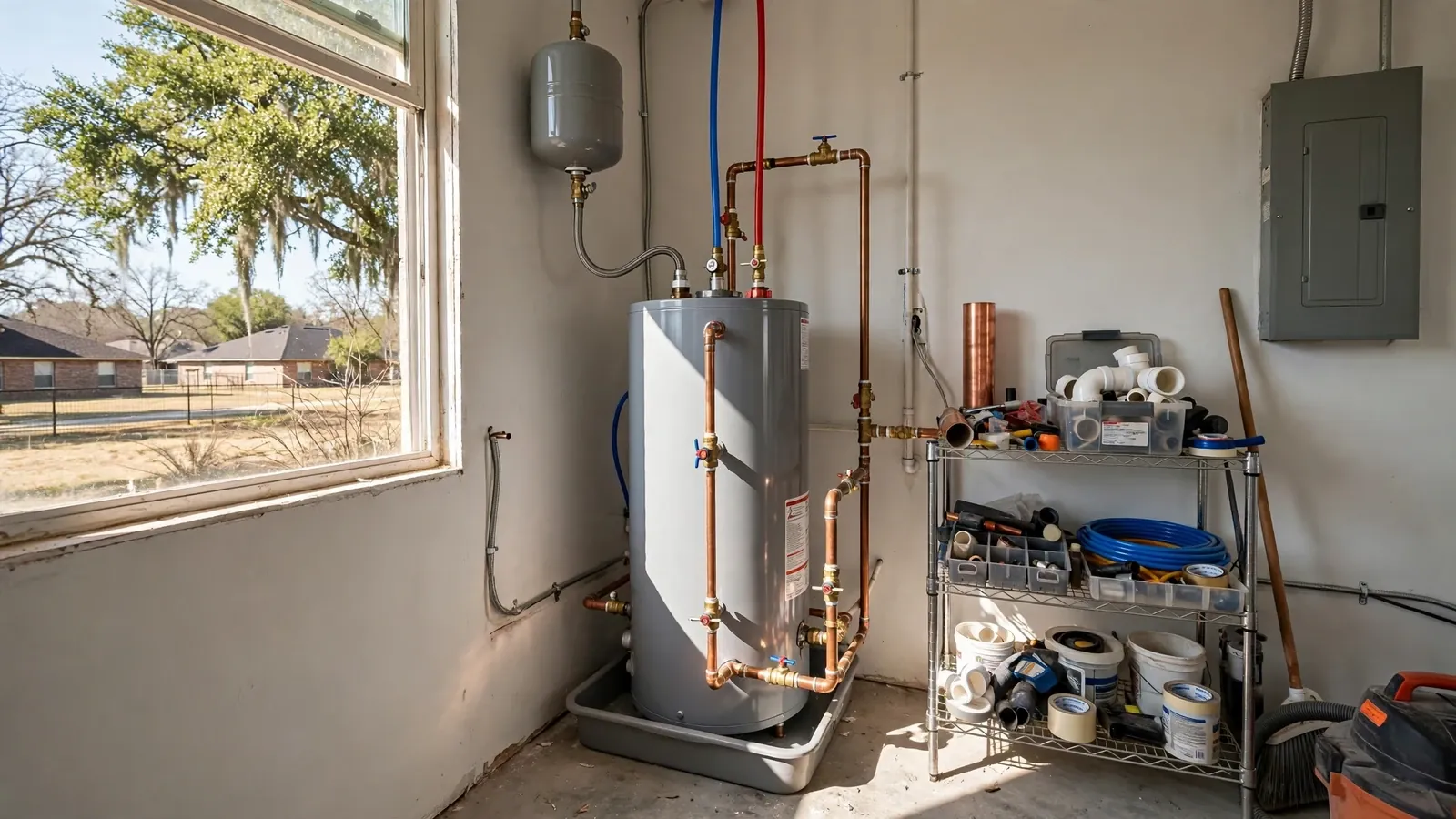
Water heater installation in Englewood, NJ is the planned job of choosing, placing, connecting and venting a new heater, whether it is a first install in a renovation or a considered upgrade. You have time here to compare options, which is the main advantage over a midnight tank failure.
A good installation depends on choices made before the old tank leaves the house: the right capacity for your household, the right fuel, a safe vent path and a drain for the relief valve. Those choices also decide whether the unit runs quietly for years.
Our line is open 24/7 if something fails mid-project. If your tank is leaking right now, jump to water heater replacement for the faster path.
Sizing a heater to the household
Tank size is only half of capacity. The number that matters at 7 a.m. is the first hour rating, which tells you how much hot water the heater can deliver in the first hour of heavy use. Two 50 gallon tanks can have different ratings depending on burner or element power.
Count your peak hour. A family running two showers, a dishwasher and a washing machine at once needs more than a couple that showers separately. Garden tubs and body-spray showers also pull hard. Tank sizes of 40 and 50 gallons are common for family homes, but the plumber should size against your actual habits, not a rule of thumb.
Going too large wastes energy keeping idle water hot. Going too small leaves the last shower cold. A short talk about who lives in the house and when they bathe is worth more than a catalog.
Before installation day
A little prep keeps the job moving once the plumber arrives.
- Clear a path and a few feet of space around the old heater.
- Find the water main shutoff and tell everyone when water will be off.
- Note whether the heater is gas or electric and where the vent exits.
- Photograph the rating plate and any labels on the flue or panel.
- Decide where the relief valve discharge pipe should drain.
- Ask whether a permit applies and who pulls it.
What the installation involves
Survey the site
The plumber checks the location, floor, drain, venting path, gas line size or electrical capacity before choosing hardware.
Remove the old unit
Water is shut off, the tank drained, the lines and vent disconnected, and the heater taken out.
Set and plumb
The new heater sits on a level base or in a drain pan. New flexible connectors, shutoffs and the relief valve pipe go in.
Connect fuel and vent
Gas piping is tested for leaks and the flue is sloped and sealed, or power is wired through a correctly sized breaker.
Fill, start and test
The tank fills before power or gas goes on. The plumber checks temperature, pressure, flame or element operation and the vent draft.
Gas or electric: picking a fuel
Gas heaters recover quickly and keep working in many outages if they use a standing pilot, though many newer models need electricity for controls. They need a gas line of the right size, a flue, and combustion air. A gas heater in a closet needs adequate air supply.
Electric tank heaters are simpler to install, need no flue and have no combustion, but they recover more slowly and need a dedicated circuit. Switching from gas to electric requires a licensed plumber to cap the old gas line, and an electrician may be needed for the panel.
Heat pump hybrids are electric heaters that use less electricity than a standard electric tank. They need space, airflow and a condensate drain, and they work best in an open basement.
Venting, the flue and the expansion tank
Gas water heaters vent combustion gases outdoors. An atmospheric vent relies on natural draft up a metal flue, while power vent and direct vent models use a fan and plastic or metal pipe through a wall. The plumber chooses based on where the heater sits and where the vent can exit.
Many homes today have a pressure reducing valve or a backflow device on the water service, which turns the plumbing into a closed system. Heating water then raises pressure, and an expansion tank absorbs the extra. It sits on the cold supply line near the heater. Whether yours needs one is a question to put to the plumber.
Every tank heater also needs a temperature and pressure relief valve with a discharge pipe running to a safe point near the floor. Do not cap or plug that pipe.
Options at a glance
Match the heater type to your house and habits, not the other way round.
| Option | Best for | Trade-off |
|---|---|---|
| Gas storage tank | Homes with gas service and a vent path | Needs flue and combustion air |
| Electric storage tank | Simple installs without a flue | Slower recovery, dedicated circuit |
| Heat pump hybrid | Open basements with floor drains | Needs space, airflow and a condensate drain |
| Tankless gas or electric | Households wanting continuous hot water | Larger gas line or heavy electrical service |
| Direct vent or power vent gas tank | Closets or finished spaces with limited flue options | Needs power and a wall penetration |
Ask for two options at different price points so you can compare features.
Planning a water heater in Englewood
Englewood has about 11,563 housing units across 4.95 square miles, with a range of building ages. Because each house must be checked individually, a plumber should look at your actual gas line, vent path and floor drain before quoting. Do not assume a neighbor's setup matches yours.
Much of northern Bergen County drinks water from Veolia's Oradell Reservoir system, so check the supplier named on your water bill, and ask that supplier for its annual water quality report. The report helps you and your plumber decide how often to flush the tank. Permit rules vary by job, so ask the Englewood Building and Code Enforcement office if your install changes the fuel, vent or gas piping. A New Jersey master plumber licence is required for plumbing work.
If your tank is failing, water heater replacement explains how to decide between the same type and a new one, and tankless water heaters covers the other option. Homeowners in Teaneck and nearby towns can call the 24/7 line to plan an install.
What affects the price of water heater installation
A planned install lets you control more of these factors than an emergency swap does.
Tank, hybrid and tankless units, and larger capacities, all carry different equipment costs.
Moving from gas to electric, or the reverse, adds piping or wiring.
A new flue, a power vent run, or a wall penetration adds parts and labour.
Expansion tank, drain pan, new shutoffs and relief valve piping are usually separate line items.
An attic, tight closet or second floor takes longer than an open basement.
Installing a new heater is usually a homeowner expense, not an insurance claim. Resulting water damage from a sudden failure may be covered. Ask your carrier about a planned upgrade and whether a newer unit affects your premium.
Call for a clear price on your install, and have your household size and current heater details handy.
Check a plumber before you hire
New Jersey law says plumbing work must be done by a licensed master plumber. Ask for the licence number, then confirm it with the State Board of Examiners of Master Plumbers, part of the New Jersey Division of Consumer Affairs.
Permit rules vary by job, so ask the Englewood Building & Code Enforcement office before work begins.
Water Heater Installation questions in Englewood
Look at first hour rating, not tank size alone. Count how many showers and appliances usually run in your busiest hour. A plumber can match that to a heater instead of guessing from a gallon number.
Many homes need one when the water system is closed by a backflow device or pressure reducing valve. Ask the plumber to test your pressure and tell you why or why not.
Often yes, but moving it means new water lines, a new relief valve drain, and for gas models a new vent or gas line. Prices climb with every foot of new pipe.
It can be if the basement has open air and a floor drain nearby. It will slightly cool the room, which some homeowners like in summer and dislike in winter.
Permit rules vary by job, so ask the Englewood Building and Code Enforcement office, which is open Monday to Friday. Do not skip this step if you change fuel or venting.
Many tank heaters run roughly 8 to 12 years. Water quality, sediment and anode rod checks affect that range, so ask your plumber about a flushing schedule.
Still not sure what you need? Call the line and describe what you see.