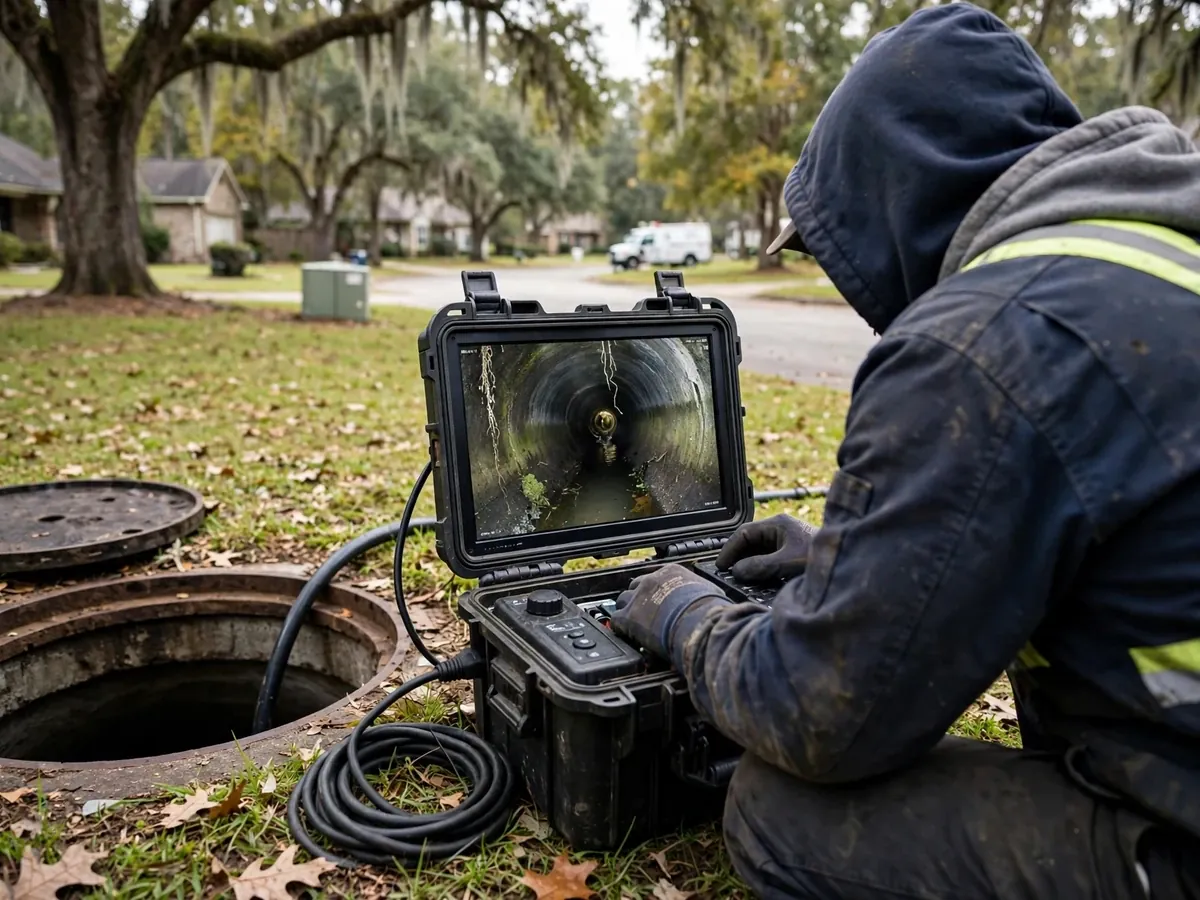
A sewer inspection in Englewood, NJ is a video examination of the pipe that carries waste from your house to the public sewer, done with a small waterproof camera on a flexible rod. That pipe is called the sewer lateral, and the part on your property is usually the owner's to maintain. Unlike an urgent backup, an inspection is a planned visit, and same-day appointments are available when the schedule allows.
People book an inspection for three common reasons. They are buying or selling a house, they have had a backup and want to know why, or a plumber has recommended lining or replacement and they want to see the proof. Each reason changes what you ask the camera to look for.
If a line fails or backs up while a project is underway, our phone line is open 24/7. The rest of this page covers what the camera shows, how to read the footage and what to do with the result.
The sewer lateral, in plain terms
The lateral runs from the drain at the foundation out to the public sewer main, usually under the yard and sometimes under the street. It is typically 4 or 6 inches across and may be clay, cast iron, fiber, PVC or ABS, or a mix. Many houses have a cleanout, a capped pipe that gives a camera a place to enter.
The lateral is easy to forget because nothing shows above ground. Defects develop slowly, so a line that works today can have root-filled joints or a sag that holds water. The camera is the only way to see these without digging.
How the camera visit runs
Choose the entry point
The plumber finds the cleanout, or pulls a toilet if the house has none.
Run the camera downstream
A push camera on a flexible cable travels toward the street while it records, and a transmitter in the camera head lets the plumber trace its position above ground.
Mark the problems
Each defect is noted by its distance from the entry point and, when the locator is used, marked on the ground above.
Review the footage together
You see the video, hear which findings are minor and which are urgent, and can ask for a copy of the recording.
What the picture can and cannot show
A camera shows pipe material, joint spacing, roots, cracks, offsets, scale, grease and standing water. It shows whether the line is round or crushed and whether a belly holds water. It also shows where branch lines enter and whether the lateral connects to the street main.
It does not show everything. A camera cannot see through a full blockage, so the line may need cleaning first. It cannot always see the public main past the connection, and it will not tell you how many more years a pipe has. Treat the footage as a snapshot, not a warranty.
Reading the report: terms you will hear
Inspection notes use a short list of words, and each one points toward a different next step.
- Root intrusion means roots have entered at a joint or crack
- An offset joint means two pipe sections no longer line up, leaving a ledge that catches paper
- A belly or sag is a low spot where water pools and waste settles
- Scale is rough rust buildup, common inside old cast iron
- A fracture is a break along the pipe wall, sometimes with soil visible through it
- A collapse is a crushed or separated section, which usually needs excavation
- A tap or connection is where a branch line joins the main, often a weak point
Buying a house with an unseen lateral
A general home inspection usually does not cover the buried sewer line, since the inspector cannot see it. A separate camera scope before closing gives you facts to use in negotiation. If the footage shows roots or a collapsed section, you can ask for a repair credit or a seller repair, or at least budget for the work.
Schedule the camera visit within your inspection contingency period, and ask the seller for access to the cleanout. Bring the footage to your attorney or agent. In an older house, expect to find some defects, so focus on whether they are minor or structural.
Good reasons to schedule one
The same camera answers different questions depending on why you booked it.
| Situation | What to ask the camera | What you decide |
|---|---|---|
| Buying a house | Material, roots, sags and collapse | Negotiate, repair or walk away |
| Selling a house | Whether defects exist before a buyer finds them | Fix first, or disclose and price accordingly |
| Repeat backups | Where the blockage forms and why | Repair, line or schedule cleaning |
| Before lining | Whether the pipe is round, continuous and free of bellies | Lining or another method |
| Remodel or addition | Where the lateral runs and its condition | Move, protect or replace before building |
| Tree work or new planting | How close roots are to joints | Choose plantings or repair the joints |
A clear lateral in good shape is a useful result too, because it lets you stop worrying.
Camera first, lining second
A liner is only as good as the pipe it goes into. Before lining, a camera shows whether the pipe is round, whether any section has separated, and whether a belly will hold water after the liner cures. A cleaning pass usually comes first, because the liner needs a clean wall.
If the footage shows a collapse or a deep sag, lining is the wrong tool and the plumber should say so. Then the next page to read is sewer line repair, which covers spot repairs and replacement. If the lateral is simply dirty, hydro jetting may be all it needs.
What affects the price of a sewer inspection
A camera visit is usually a smaller job than a repair, and these factors set the price.
A working cleanout allows quick entry, while pulling a toilet or locating a buried line adds time.
Long laterals and extra turns take longer to run.
If the camera cannot pass a blockage or heavy grease, the line must be cleaned first, which is a separate service.
Tracing the line above ground and marking defect depth adds time but helps if a repair follows.
A written summary and a copy of the video may be priced separately or included, so ask before the visit.
An inspection is an information and maintenance expense and is usually not covered by homeowners insurance. If a sudden accidental discharge caused damage, ask your carrier whether they want to see the footage.
Call to book a camera visit and get a clear price before work starts.
Englewood houses, records and who to ask
Englewood has 11,563 housing units in a city incorporated in 1899, with rail service arriving in 1859. Houses went up across many decades, and some laterals have been patched, rerouted or replaced along the way. Ask the seller for records of past sewer work in this part of Bergen County, then compare them with what the camera shows.
The Englewood Building & Code Enforcement office, at 2-10 North Van Brunt Street, handles permits, so it is the place to ask whether any past plumbing work at an address was permitted. What is on file for a given address is for the office to say, so call before you rely on it.
The camera result decides what happens next, whether that is sewer line cleaning for roots and grease or sewer line repair for a cracked pipe. The same visit is available for homes in Leonia and the other nearby towns.
Check a plumber before you hire
New Jersey law says plumbing work must be done by a licensed master plumber. Ask for the licence number, then confirm it with the State Board of Examiners of Master Plumbers, part of the New Jersey Division of Consumer Affairs.
Permit rules vary by job, so ask the Englewood Building & Code Enforcement office before work begins.
Sewer Inspection questions in Englewood
Many are done in about an hour when there is a working cleanout and the line is clear. A long lateral, a blockage that needs cleaning first or a hard-to-find entry point stretches that out.
Only the stretch it can reach. A residential camera usually follows your lateral to where it meets the main and may peek into the main at the connection. Deeper inspection of the public main is the job of the town or the sewer authority.
Yes, because a general inspector cannot see a buried pipe. Fixtures that drain well on inspection day say little about roots, a sag or a cracked joint below the yard.
It helps. Watching the footage live lets you ask about each finding on the spot. If you cannot be there, ask for a recording and a written summary.
You get the footage, an explanation of each defect and the options, which may be cleaning, spot repair, lining or replacement. You decide what to do, and there is no obligation to book the repair with the same company.
Find the cleanout if you can and clear a path to it. Avoid running large amounts of water in the hour before the visit, since it can make the line harder to read. Tell the plumber about any past backups or repairs.
Usually the line has to be cleaned first so the camera can pass. That turns the visit into a cleaning job followed by an inspection, and it is worth mentioning when you call.
Still not sure what you need? Call the line and describe what you see.