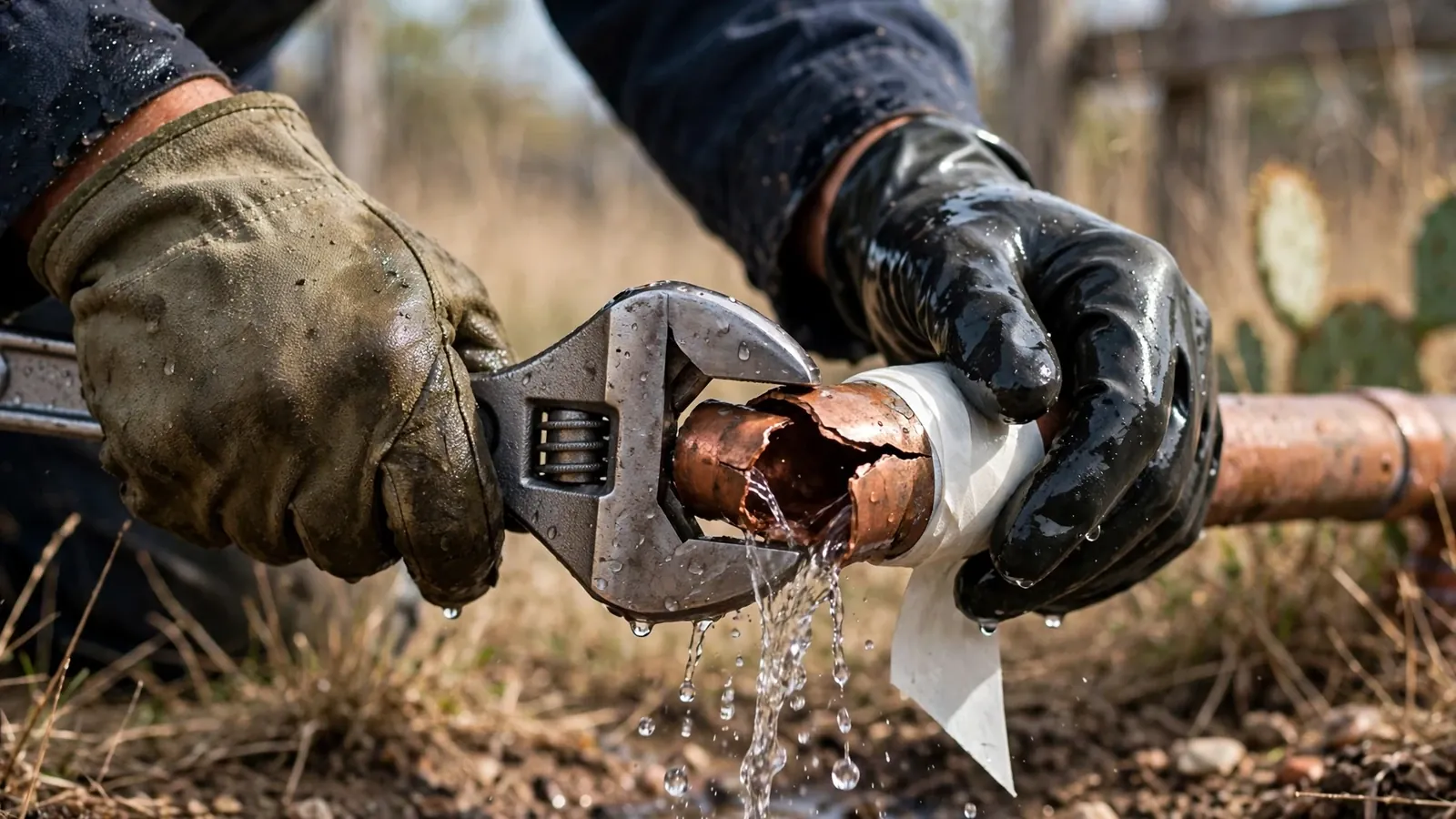
A burst pipe can release hundreds of gallons into a house within an hour, so speed counts and our line is open 24/7. Burst pipe repair in Englewood, NJ means stopping the flow, finding the failed section of supply or drain pipe, and replacing it so the line holds pressure again. The steps below take about a minute and can limit damage before a plumber arrives.
Pipes fail in different ways. Copper pinholes from corrosion, a split from a hard freeze, a cracked cast iron stack, a broken supply valve and a loose fitting each need a different repair, and the cause tells us whether more of the pipe is at risk.
Signs a pipe has failed
Some bursts are loud and some are slow, so look for these.
- Water spraying, dripping through a ceiling or pooling under a sink
- A sudden drop in water pressure across the house
- Stains, bubbling paint or warm spots on a wall or floor
- The sound of running water when everything is off
- A water meter that keeps turning with all fixtures closed
- Rusty or discoloured water, or a damp smell in a closet
Stop the water now, then protect the house
Go straight to the main water shutoff. It is usually where the supply enters the house, often in the basement near the meter. A wheel handle closes clockwise, and a lever closes with a quarter turn. Learn its location before you need it, and if it will not turn, call us at once.
Once the water is off, open the lowest faucet in the house and a high one to drain what remains in the pipes. If water is near outlets, appliances or the panel, do not touch them. Shut off power only at a dry panel, and otherwise call the electric utility or 911.
- Close the main shutoff valve, then open taps to drain the lines
- Switch off the water heater power or set its gas control to pilot per the maker's instructions, so it does not run dry
- Stay out of rooms with water near live outlets or a wet panel
- Move furniture, rugs and electronics out of the wet area
- Photograph and video the damage and the pipe before cleanup, for your insurance claim
- Mop up standing water only where it is clearly away from live power
- Keep the broken section if you can, since it helps show the cause
Which pipe failed and how it is usually repaired
The material and the failure type decide the fix.
| Pipe or part | How it fails | Typical repair |
|---|---|---|
| Copper supply line | Pinholes from corrosion, splits from freezing | Cut out the damaged length and fit new copper or press fittings |
| Frozen pipe, still intact | Ice blocks flow and may have split the wall | Thaw safely, inspect for splits, repair what failed |
| Cast iron drain or stack | Rust-through, cracks, failed joints | Replace sections with no-hub couplings or new pipe |
| Galvanized steel | Rust inside, pinholes at threads | Replace the run, as patching often leads to more leaks |
| Supply valve or angle stop | Seized stem, cracked body, leaking packing | Replace with a quarter-turn valve |
| Plastic supply or drain fitting | Cracked fitting, bad glue joint, impact | Cut out and replace the fitting or section |
If one section fails because of age, the pipe nearby is often in similar shape, and we will say so.
Copper pipe repair
Copper is common in homes of many ages, and it fails in a few predictable ways. Tiny pinhole leaks usually come from corrosion inside the pipe, while a long split along the side points to freezing. A single pinhole may be fixed with a short replacement, though several holes mean the line is wearing out.
Repair means cutting out the bad length and joining new pipe with soldered fittings or press fittings. We confirm the pipe is dry and the system depressurised first. If a whole run is wearing out, a repiping project may serve you better than patching every few months.
Cast iron and drain pipe breaks
Cast iron drain stacks and house drains carry waste, so a break may leak sewage and not clean water. Older cast iron rusts from the inside, develops scale and cracks near joints. Signs include slow drains, sewer odour, stains around the pipe and wet spots in walls or under the slab.
A short cracked section can be cut out and replaced with plastic pipe and heavy rubber couplings, but pipe that is scaled throughout may fail again elsewhere. A camera inspection shows how much of the line is sound. Buried drain breaks overlap with sewer line repair, which we handle as well.
Frozen pipes and what happens when they thaw
Pipes most likely to freeze run along exterior walls, through unheated crawl spaces and garages, and into outside faucets. Water expands as ice forms and can split the pipe, but the leak often only shows once the ice melts.
If you find a frozen pipe, open the nearest faucet, then warm the pipe slowly with a hair dryer starting at the faucet end. Never use an open flame, torch or heater that can start a fire. If the pipe is behind a wall or you cannot reach it, call us, and keep the main shutoff in reach in case it splits.
Old houses, apartment risers and where to turn the water off
Englewood is a long-settled city, so many houses are probably older, though each one differs. Houses of that age often mix copper, galvanized steel and cast iron from different eras of repair, and a repair that joins them needs careful fittings.
Leonia's oldest dwelling, the Cole-Allaire House, dates to about 1765, which shows how old some of that borough's housing can be. In Fort Lee, where many high-rise buildings stand, a burst pipe in one unit may be on a building riser, so call building management to shut the water off for the floor. Our Fort Lee plumbing service page covers that area.
What affects the price of pipe repair
A reachable valve costs little, while a hidden slab leak is a large job, so the location drives the work.
A 1/2-inch copper repair differs from a 4-inch cast iron stack.
An open basement ceiling is quick, while a pipe behind tile or plaster takes cutting and patching.
One short section costs less than a long run or several failed sections.
Drying, drywall and flooring are separate trades, which we can coordinate.
Night and weekend callouts may cost more than a scheduled daytime visit.
Insurance often covers sudden and accidental discharge, such as a pipe that bursts in a freeze, including resulting water damage. Gradual leaks, corrosion and wear are generally excluded. Document everything with photos and ask your carrier before repairs begin.
Call now and we will help you get the water off and give you a clear price before work starts.
Check a plumber before you hire
New Jersey law says plumbing work must be done by a licensed master plumber. Ask for the licence number, then confirm it with the State Board of Examiners of Master Plumbers, part of the New Jersey Division of Consumer Affairs.
Permit rules vary by job, so ask the Englewood Building & Code Enforcement office before work begins.
Burst Pipe Repair questions in Englewood
Yes. Dispatch is open 24/7, and a burst pipe is exactly the kind of call that should not wait for Monday. Tell us where the water is and whether you have reached the main shutoff, and we will coach you while a plumber is on the way.
Look near where the water line enters the house, often in the basement, a utility closet or a crawl space, close to the meter. The valve is a round wheel or a lever. If you cannot find it, there may also be a curb valve outside, which the water supplier usually controls.
Only if the panel is dry and you can reach it without standing in water. If water is near the panel or outlets, stay out and call the electric utility or 911. Water and live electricity can be deadly.
Sometimes. A small access panel is enough for some repairs, but hidden pipes often need a section of wall opened. We try to find the break first with a leak detection visit, so we cut where it counts.
Insulate pipes in cold spaces, disconnect outdoor hoses, and keep heat on in the house. In a hard freeze, a trickle at a vulnerable faucet can help. If you leave town, keep the heat set above 55 degrees.
Many policies cover sudden bursts and the damage that follows, but not slow leaks or old pipe that simply wears out. Take photos before cleanup and ask your insurer what they need.
Still not sure what you need? Call the line and describe what you see.