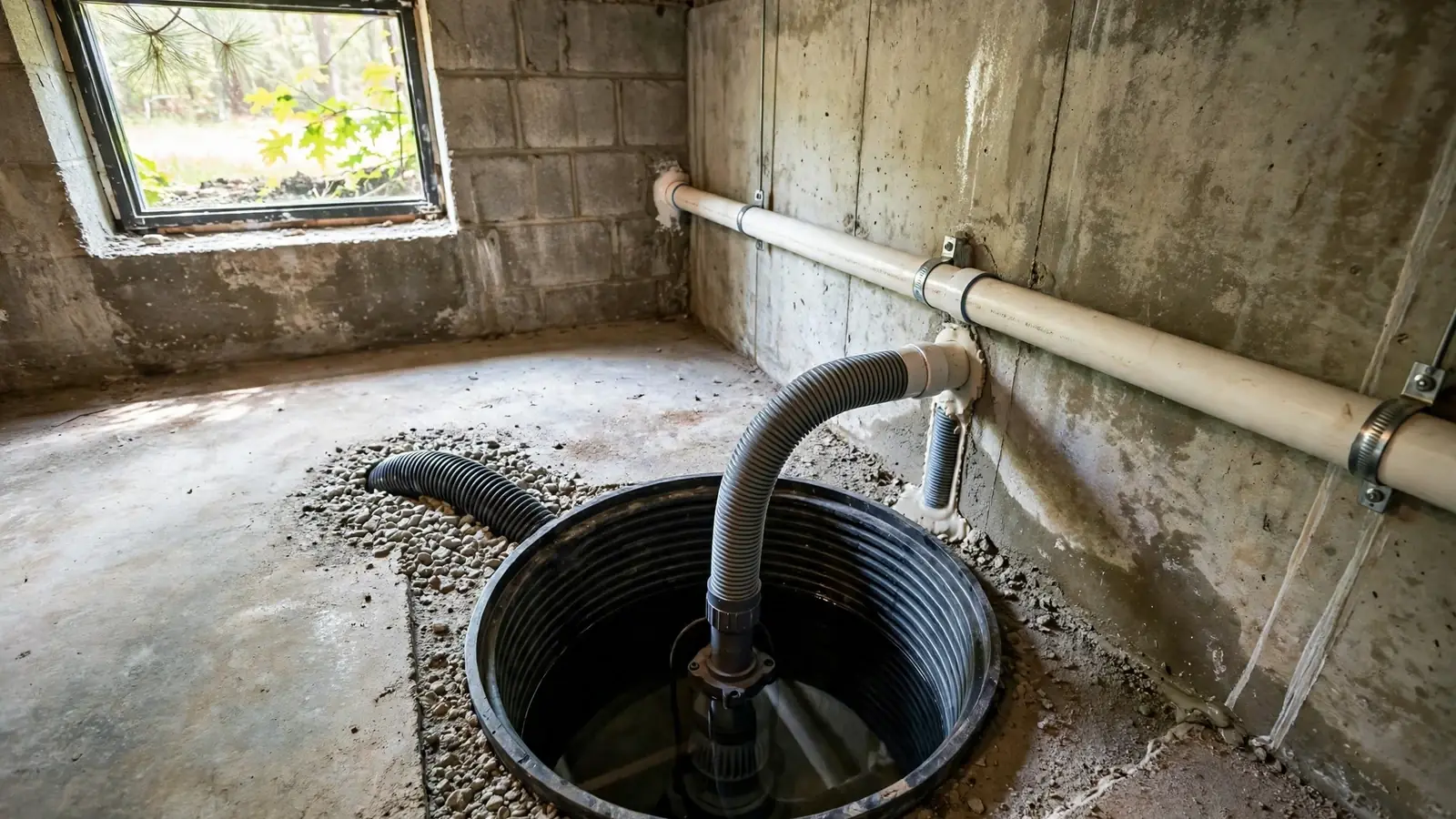
Installing a sump pump costs a few hundred to well over a thousand dollars when you are swapping a pump into an existing pit, and often a couple thousand dollars or more when a new pit has to be cut into the slab. These are general industry ballparks, not quotes for Englewood, NJ.
The big price swing is the pit. Replacing a worn pump, the core of sump pump installation and repair, takes about an hour or two of work. Breaking concrete, digging a basin, and running a discharge line is a much bigger job. Battery backup and discharge routing add to either.
A swap versus a brand new pit
If a pit with a liner and a discharge line already exist, replacing the pump is mostly the pump and an hour or two of labor. The plumber disconnects the old unit, sets the new one on a stable base, and ties it to the check valve and discharge line.
A new pit is different. A crew has to cut and break a section of the basement slab, dig out soil, set a basin with a perforated lining, backfill, and patch the concrete. That is labor, mess, and cure time, which is why prices jump.
Because of that, ask whether a failed pump is actually the issue before assuming the pit needs replacing. A clogged intake or a stuck float often looks like a dead pump.
Pedestal pump versus submersible pump
The two common pump styles trade price, noise, and service life.
| Feature | Pedestal pump | Submersible pump |
|---|---|---|
| Where the motor sits | Above the pit on a column | Inside the pit, underwater |
| General price | Lower | Higher |
| Noise | Louder | Quieter |
| Fits narrow pits | Yes | Needs a pit wide enough for the float to move |
| Heat and service | Easier to service, motor stays dry | Cooler running, harder to reach |
| Best for | Occasional use in a tight pit | Frequent use and finished basements |
A plumber can tell you which style your pit and your basement use favor.
General industry ballparks
Wide, rounded ranges for planning only. Local prices vary, and none of this is a quote.
| Job | General ballpark |
|---|---|
| Pump swap into an existing pit | $400 to $1,500 |
| New pit, pump, and basic discharge line | $1,500 to $5,000 or more |
| Battery backup system added | $500 to $2,000 |
| Discharge line reroute or extension | A few hundred to a couple thousand |
| High-water alarm added | Under a hundred to a few hundred |
Longer discharge runs, hard-to-access basements, and electrical work for a dedicated outlet push a job toward the top.
Why battery backup is worth pricing
Heavy storms are exactly when the power goes out, and a pump with no power does nothing. A battery backup runs a second pump from a marine-style battery for a limited time. The battery needs periodic testing and replacement.
Backup does not make a pump unlimited. The run time depends on battery size and how hard the water is coming in. Think of it as a bridge until the power returns, not a generator.
Ask for the model type, the expected run time, and an alarm. A high-water alarm that tells you the pit is filling is one of the cheapest forms of protection.
What the discharge line does and where it goes
Check valve
A one-way valve near the pump keeps water in the pipe from running back into the pit.
Exit through the wall
The pipe leaves the basement and ends outdoors, usually a short distance from the house.
Choose a safe discharge point
Water should move away from the foundation and away from neighbors' property.
Avoid freezing and clogs
A pipe end that cannot ice over, or an alternate outlet, prevents a backup in winter.
Keep it out of the sanitary sewer
In many places that is not allowed, so confirm local rules before connecting anywhere.
What should be on the quote
Look for these items in writing.
- Pump type, horsepower, and brand category
- Whether a new pit is included or an existing one is reused
- Check valve and discharge pipe material and length
- Battery backup and alarm, if requested
- Electrical outlet requirements, and who handles them
- Slab patching and cleanup
Keeping a new pump working
Test the pump a couple of times a year by pouring a bucket of water into the pit. The float should lift, the pump should start, and the water should drain. Listen for grinding or a pump that runs without moving water.
Clear debris from the pit so the float is free. Check that the discharge pipe end is clear and that snow or ice has not blocked it. If a basement floods anyway, keep out of standing water near electrical outlets.
A pump is only part of a basement that stays dry. If the water keeps returning, see the waterproofing options for the larger picture.
What Englewood and Bergen County homeowners should know about sump pumps
Tenafly's East Hill rises sharply east of downtown toward the Palisades, and water follows slope. A discharge line on a hillside lot should send water somewhere that does not erode the yard or flow onto a downhill neighbor. Ask the plumber where the pipe will end and how the water will move once it leaves.
In Leonia the range from about 5 feet in the west to about 318 feet in the east means pump demand can differ a great deal between neighboring blocks. A basement in the low western end may run its pump far more often. Plumbing work requires a New Jersey master plumber, and permit rules vary by job, so ask the Englewood Building & Code Enforcement office or your own town's office.
Source type: municipal census and terrain data, city building dept contact page.
Check a plumber before you hire
New Jersey law says plumbing work must be done by a licensed master plumber. Ask for the licence number, then confirm it with the State Board of Examiners of Master Plumbers, part of the New Jersey Division of Consumer Affairs.
Permit rules vary by job, so ask the Englewood Building & Code Enforcement office before work begins.
Questions homeowners ask
Many last roughly seven to ten years, but heavy use shortens that. A pump that runs often in a wet area may wear out sooner. Annual testing catches early failure.
Swapping a pump into an existing pit is a common DIY project if the power is off and you are comfortable with plumbing. Cutting a new pit and wiring a dedicated circuit is a different job. Electrical work near water is a safety issue.
Many homes use a one-third horsepower unit, but the right size depends on how much water arrives and how high it must be lifted. A plumber can size it from the pit, the discharge height, and the water inflow.
Sloped terrain moves rainwater downhill toward lower basements, and the groundwater level can rise quickly after heavy rain. A pump that cycles often after storms is doing its job. If it never shuts off, call a plumber.
Electricity costs are small because it only runs during outages or failures. The ongoing cost is replacing the battery every few years. Ask the installer how often to test it.
Still not sure what you need? Call the line and describe what you see.
Call (551) 249-3045