No dig sewer line repair in Englewood, NJ means fixing the pipe between your house and the sewer main without trenching the whole yard. The two main methods are lining the old pipe from the inside and pulling a new pipe through the old path, as covered on our sewer line repair page. Both need only a couple of small access pits.
It works when the pipe is still roughly in line and has not fully collapsed. A camera inspection decides that, so the video comes before any promise about lining, bursting, or a spot repair. Some failures still need a dig, and an honest plumber will say so.
Why the camera comes before any quote
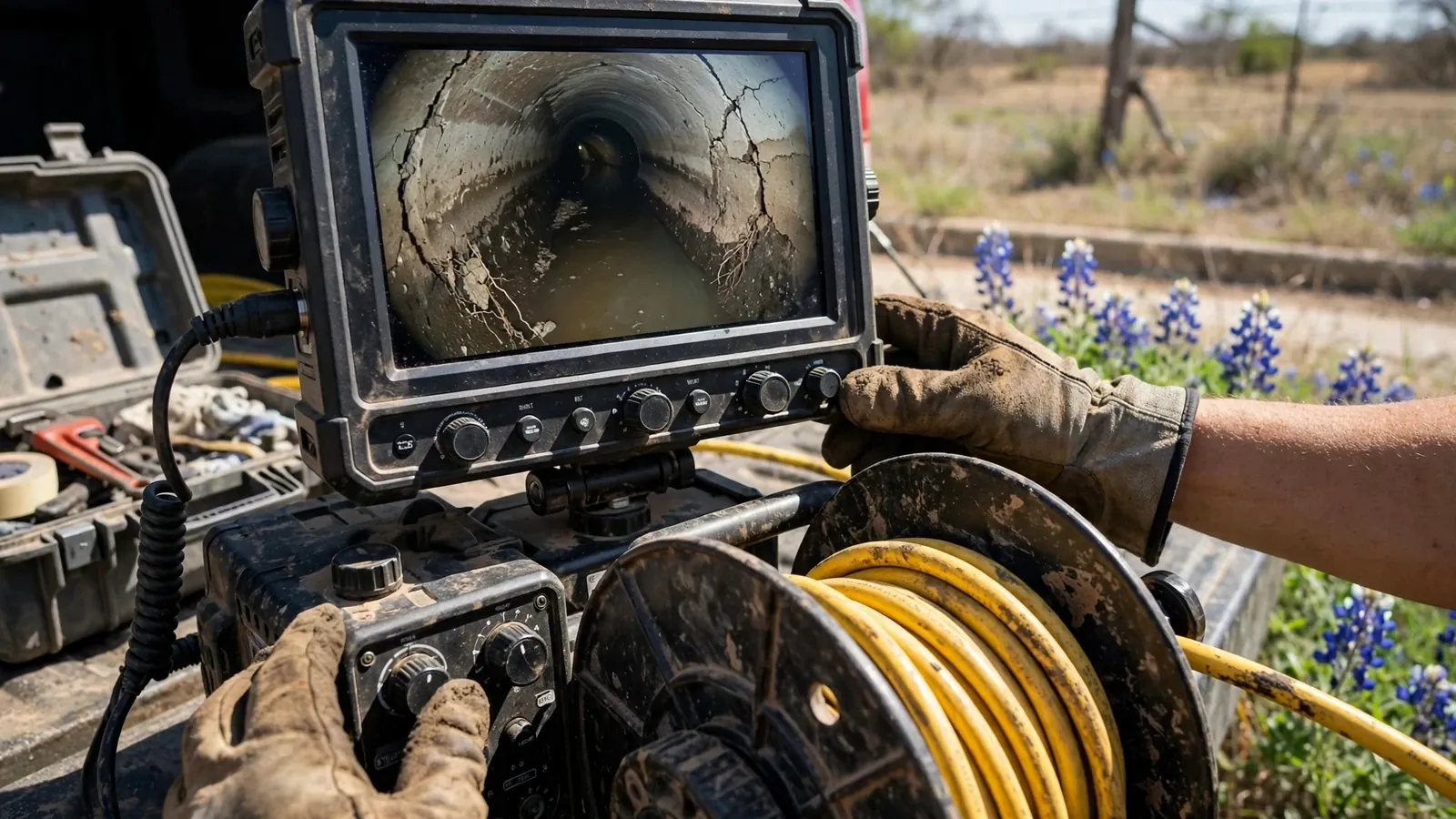
A sewer line is buried, so nobody can judge it by looking at the lawn. A licensed plumber feeds a small waterproof camera into the line through a cleanout and watches the pipe wall on a monitor. The camera cable is marked with footage, and a locator can find the camera head from above ground.
That gives you three facts you need before spending money. First, what the pipe is made of, such as clay tile, cast iron, Orangeburg fiber pipe, or plastic. Second, what is wrong with it, such as roots in the joints, a cracked wall, a sag, or a collapse. Third, how far from the house the problem sits.
Ask for the recording or a clear summary with footage marks. If a company quotes a large repair without showing you the inside of the pipe, get a second opinion. A basic sewer camera inspection costs far less than guessing wrong.
Lining, bursting, spot repair, and full replacement side by side
Each method fits a different kind of damage. Use this as a starting point, then let the camera footage settle it.
| Method | Best for | Main limit |
|---|---|---|
| Pipe lining (cured in place) | Cracks, root intrusion at joints, small gaps, pipe that is still in line | Cannot fix a collapse or a deep sag, and the pipe gets slightly narrower |
| Pipe bursting | Badly cracked or deteriorated pipe that is still straight enough to follow | Needs an entry pit and an exit pit, and nearby utilities must be located first |
| Spot repair (small dig) | One failed section, such as a broken joint or a crushed stretch | Rest of the old pipe stays, so other weak spots can show up later |
| Open trench replacement | Collapsed pipe, major sags, wrong slope, or pipe that was never connected right | Most disruption to lawn, driveway, and landscaping |
A line with several different problems along its length often ends up as a mix, such as lining one run and digging one short section.
How lining works inside the old pipe
Lining starts with cleaning. The plumber clears roots and scale with a jetter or cutter so the liner can sit tight against the pipe wall. The camera goes in again to confirm the pipe is clean and the path is clear.
A flexible tube soaked in resin is then pulled or inverted into the pipe and inflated. Heat, steam, or light cures the resin until it hardens into a new pipe inside the old one. Once cured, a cutter reopens the side connections, such as the line from a second bathroom group.
The liner is smooth and has no joints for roots to enter. The trade-off is a small loss in inside diameter, which rarely matters for a house line. Lining does not fix a pipe that has dropped out of alignment or holds water in a sag, because the liner follows the shape it is given.
How pipe bursting replaces the line
In pipe bursting, a cone-shaped head is pulled through the old pipe by a cable. It breaks the old pipe outward into the soil while drawing a new plastic pipe, usually HDPE, behind it. The result is a brand new pipe of the same or slightly larger size along the same path.
This suits old clay or cast iron lines that are too far gone for lining but still run in a fairly straight path. It also lets the plumber upsize a line when that makes sense.
Bursting does shake the ground. Any gas line, water service, or electric cable close to the sewer has to be located first, so utility locating, including the free 811 call, comes before any pit is dug. Ask how the plumber plans to protect neighboring utilities.
When digging is still the right call
These camera findings usually point away from a no dig fix.
- A section of pipe that has fully collapsed or been crushed flat
- A deep sag, called a belly, where water sits and solids settle
- A joint that has pulled apart or shifted so far that a liner cannot pass
- Pipe that slopes the wrong way or was laid with too little fall
- A broken connection at the main or a failed fitting that needs direct access
- Orangeburg pipe that has gone oval, since it may not hold a liner or survive bursting
What disruption looks like on a small lot
Many Bergen County lots are small, with a driveway on one side and a mature tree or two between the house and the street. A full trench can mean cutting the driveway, moving shrubs, and leaving a muddy strip for weeks. A no dig job usually needs one pit near the house and one near the property line or curb.
Plan for noise from a pump or compressor, a truck parked near the cleanout, and a day or two without usable plumbing in some cases. You may be asked to avoid running water while a liner cures. Ask in advance how long that window lasts.
Whatever the method, a licensed plumber should explain how the work connects at the street. If the problem sits in the public section of the line, the municipality or sewer authority may be involved. Ask the Englewood Building & Code Enforcement office, because permit rules vary by job.
What a typical no dig repair day looks like
Locate and clean
The plumber marks the line from above, clears roots and debris, and records a fresh camera run.
Open small access points
One or two pits go in at the cleanout and at the far end of the damaged section, with soil kept on a tarp.
Install the liner or new pipe
The liner is cured, or the new pipe is pulled in behind the bursting head.
Reopen connections and re-scan
Side lines are cut open, then a final camera pass confirms a clear, smooth pipe.
Backfill and restore
Pits are filled and compacted, and the plumber explains what surface repair, if any, you still need to arrange.
What Englewood and Bergen County homeowners should know about no dig sewer repair
Englewood has been settled since the Erie Railroad Northern Branch started passenger service here in 1859, and the city packs roughly 5,951 people into each square mile. Many houses are older, and each one has to be judged on its own camera footage. Tight lots are exactly where a no dig method saves the most lawn and driveway.
Elevation matters for sewer slope and depth. Leonia ranges from about 5 feet in the west to about 318 feet in the east, so a line in one part of that borough can behave very differently from a line a few blocks away. Tenafly's East Hill rises sharply east of downtown, so plumbers working there deal with steeper runs. Ask the plumber how the grade on your street affects the repair plan.
Source type: city building dept contact page, municipal census and elevation data.
Check a plumber before you hire
New Jersey law says plumbing work must be done by a licensed master plumber. Ask for the licence number, then confirm it with the State Board of Examiners of Master Plumbers, part of the New Jersey Division of Consumer Affairs.
Permit rules vary by job, so ask the Englewood Building & Code Enforcement office before work begins.
Questions homeowners ask
A properly cured liner or a new HDPE pipe is meant to last for decades, but the length of life depends on the condition of the rest of the line. A liner does not fix problems outside the section it covers. Ask your plumber what the camera showed on the stretches that were not repaired.
Roots can still try to enter at the ends of the liner or at untreated joints. The smooth lined section gives them no gaps to use, so regrowth inside it is unusual. Trees close to the line may still need attention at the connection points.
Usually yes for some part of the day, because the line must be clear while the liner is installed or cured. Ask the plumber for the expected window and plan showers and laundry around it. Line up a backup restroom for that stretch.
No. Clogs in the house drain, a blocked vent, or a problem in the public main can look the same from inside the house. A camera run and a look at where the backup appears help separate those causes before anyone digs.
Ask what the camera showed, how many feet will be lined or replaced, how many pits will be dug, and what restoration is included. A clear written price before work starts is the baseline. Compare the scope, not only the total.
Still not sure what you need? Call the line and describe what you see.
Call (551) 249-3045