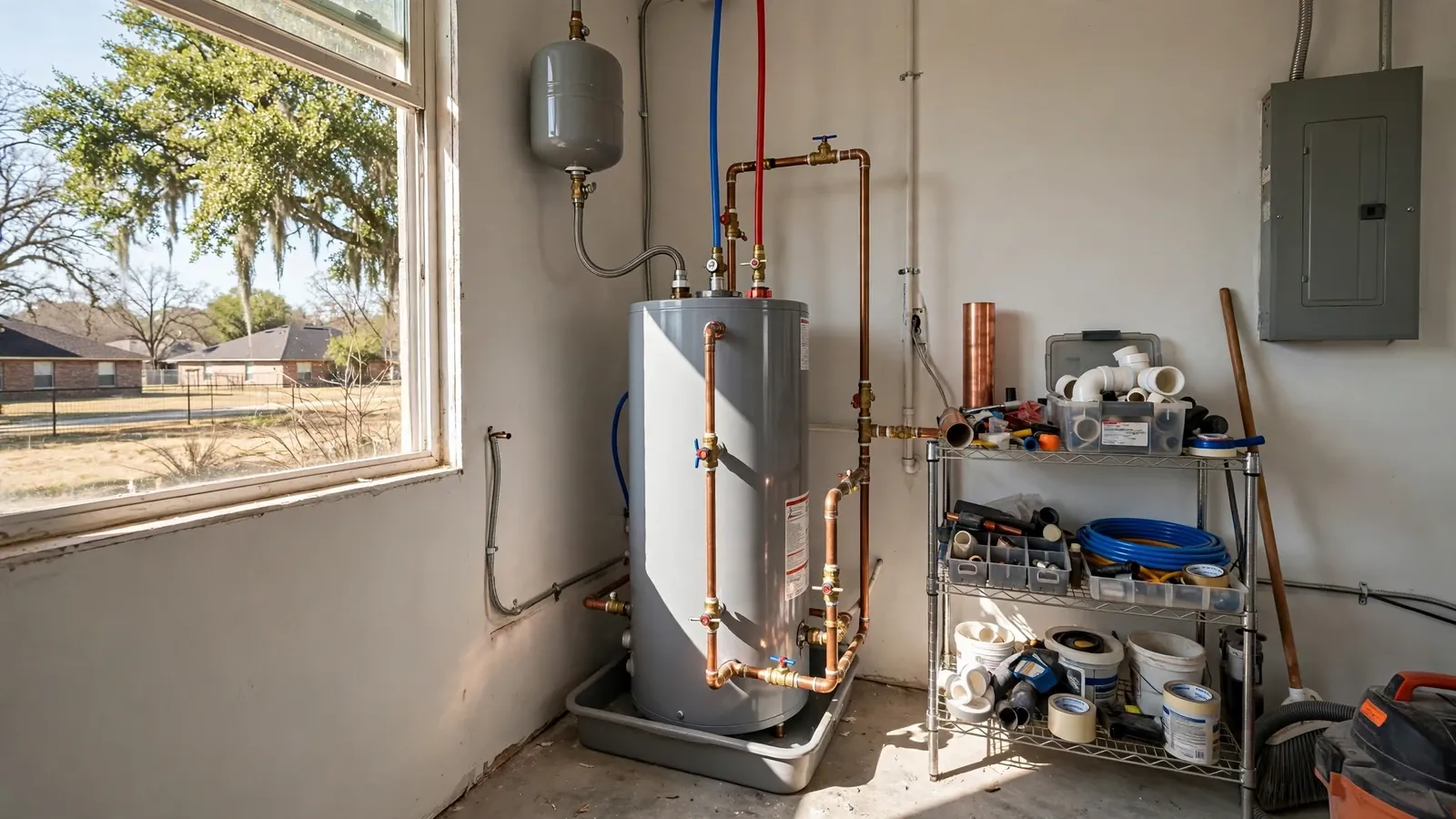
In New Jersey, the honest answer is no, not legally. The State Board of Examiners of Master Plumbers says plumbing work is to be done by a licensed master plumber, and a water heater swap is plumbing work.
The legal point is only part of it. A water heater touches gas or high-amperage electric power, a flue that carries exhaust out of the house, and a pressure vessel full of hot water. Homeowners in Englewood, NJ can safely do the maintenance around it, but the install itself should go to a licensed plumber.
What the New Jersey law says
New Jersey law says plumbing shall only be performed by a master plumber, along with authorized plumbing contractors and their employees. The rule comes from the State Board of Examiners of Master Plumbers, part of the Division of Consumer Affairs. It is there to protect the people who live in the house after the work is done.
Because of that rule, a homeowner who connects a water heater alone can run into trouble at several points. The town may not issue or sign off a permit to someone who is not licensed, an insurer may question a claim tied to unlicensed work, and a buyer's inspector may flag it at resale.
Permit rules vary by job, so ask the Englewood Building & Code Enforcement office what applies in your case. Owners in Tenafly or Englewood Cliffs should ask their own borough's building department.
DIY risk by task
Not every water heater job carries the same risk. This table separates what you can do from what should go to a licensed plumber.
| Task | Homeowner or licensed plumber | Why |
|---|---|---|
| Check the temperature setting and the pressure relief valve discharge pipe | Homeowner | Visual check, no tools on the plumbing |
| Drain a few gallons to flush sediment | Homeowner, if comfortable | Standard maintenance, but know where the shutoffs are |
| Inspect the anode rod condition | Homeowner or plumber | Needs the right socket and a way to pull it, so many people skip it |
| Disconnect and connect the water supply lines | Licensed plumber | Plumbing work under state law |
| Gas line connection and gas valve | Licensed plumber | A leak or poor connection can cause fire or explosion |
| Flue and venting changes | Licensed plumber | Poor venting can send carbon monoxide into living space |
| Electrical hookup for an electric heater | Licensed electrician | High-amperage circuit, and a mistake can cause a fire |
The upper rows are fine to try. The rest are where installs go wrong and where the legal exposure sits.
The three hazards that make this more than a plumbing job
Gas is the first. A gas water heater has a supply line, a shutoff valve, and a burner that needs a clean, correctly sized flow of fuel. A poorly sealed connection can leak, and leaks are not always easy to smell. If you ever suspect a gas leak, leave the building and call the gas utility or 911 first.
Venting is the second. Combustion gases from a gas heater must leave through a flue pipe with the right slope, joints, and clearances. A flue that is disconnected or backdrafting can spill carbon monoxide into the home, which you cannot see or smell.
Pressure is the third. A tank heater stores water at household pressure and heat, and it relies on a temperature and pressure relief valve to protect it if the thermostat fails. A missing or blocked relief valve is a real hazard. Many installs also include an expansion tank so pressure from heated water does not strain the system.
What a proper installation involves
Choose the right unit
Match the tank size to the household and the fuel type to what the house already has. A plumber also checks the space, venting path, and clearances.
Shut off and drain the old heater
Water, gas, or power are turned off. The tank is drained to a floor drain or outside and disconnected.
Set the new unit and connect the water
Supply lines, shutoff valves, and the relief valve discharge pipe go in with code-appropriate materials. Dielectric or flex connectors are chosen for the pipe type.
Connect fuel or power
Gas connections get leak-tested, and electric units need a properly sized circuit hooked up by someone qualified.
Vent, fill, and test
The flue is attached and checked for draft. The tank fills with a hot tap open to release air, then the unit is lit and checked for leaks.
Sign off
Where a permit applies, the municipal inspector may need to see the finished work. Ask your plumber who handles that step.
What homeowners can do to extend a heater's life
These steps carry far less risk than an install, and they help the heater last.
- Lower the temperature setting to a level that is hot enough for you without excess scalding risk
- Lift the relief valve lever briefly and make sure water flows to the drain pipe, then let it snap shut
- Look for rust, moisture, or mineral crust on the fittings and base of the tank
- Flush a few gallons from the drain valve once a year to clear sediment
- Ask a plumber to check the anode rod if the heater is past about five years old
- Keep storage and clutter at least a few feet away from the heater and flue
Repair, replace, or install new
A heater that is leaking from the tank body is done. Water inside the tank rusts the steel, and that leak will not be fixed with sealant. Turn off the water supply and the gas or power, then call a plumber for water heater replacement before the leak damages the floor.
A heater that is only failing to heat, or that makes popping noises, may just need a part or a flush. If you are adding a heater where there has never been one, or changing fuel type, that is a new-fit job. A licensed plumber handles that as water heater installation, including venting and fuel runs.
Cost depends heavily on tank size, fuel, and venting changes. As a general industry ballpark, a straight tank swap commonly lands somewhere between $1,200 and $3,500, and moving fuel type or venting can push it higher. A clear price before work starts is the standard to ask for.
Hiring a plumber who is actually licensed
Ask the plumber for their New Jersey master plumber licence number, then confirm it with the State Board of Examiners of Master Plumbers. Licences are renewed every two years, expiring on June 30 of odd-numbered years, so ask whether the licence is current.
Ask whether the quote includes the permit if one applies, the old heater haul-away, and any new valves or an expansion tank. A written scope helps you compare two quotes fairly.
What Bergen County homeowners should know about water heater work
Under N.J.S.A. 13:32-3.3(a)3, plumbing work is to be performed by a master plumber, along with authorized plumbing contractors and their W-2 employees. Master plumber licences expire every two years on June 30 of odd-numbered years. That is a state rule, so it applies to a house in Englewood, in Tenafly, or in Englewood Cliffs.
The City of Englewood Building & Code Enforcement office is at 2-10 North Van Brunt Street and is open Monday to Friday, 9:00 a.m. to 5:00 p.m., excluding holidays. Under New Jersey's Uniform Construction Code the municipality has a plumbing subcode official who reviews permit applications. The city's pages do not spell out plumbing permit rules, so ask the office before any work starts.
Source type: NJ Division of Consumer Affairs, State Board of Examiners of Master Plumbers, Englewood Building & Code Enforcement.
Check a plumber before you hire
New Jersey law says plumbing work must be done by a licensed master plumber. Ask for the licence number, then confirm it with the State Board of Examiners of Master Plumbers, part of the New Jersey Division of Consumer Affairs.
Permit rules vary by job, so ask the Englewood Building & Code Enforcement office before work begins.
Questions homeowners ask
State law says plumbing is to be done by a master plumber, and a water heater connection is plumbing work. Rules about homeowners vary in practice, so ask your local building department how it treats the job. A licensed plumber avoids the question.
Turning off the breaker is only the start. The water connections are still plumbing work, and a mis-sized circuit or loose wiring is a fire hazard. Both parts are best left to licensed trades.
A straightforward tank swap often takes a few hours. Longer times come from venting changes, a new gas line, a corroded shutoff valve, or electrical work. Ask the plumber what they expect for your setup.
It may not. Insurers often question claims tied to unlicensed or improper work. Ask your carrier before you decide, and keep paperwork from any licensed install.
Call the building department of the town where the house stands. The permit follows the property, not the plumber's office address. Your plumber can tell you the usual process, but the town sets the rules.
Still not sure what you need? Call the line and describe what you see.
Call (551) 249-3045