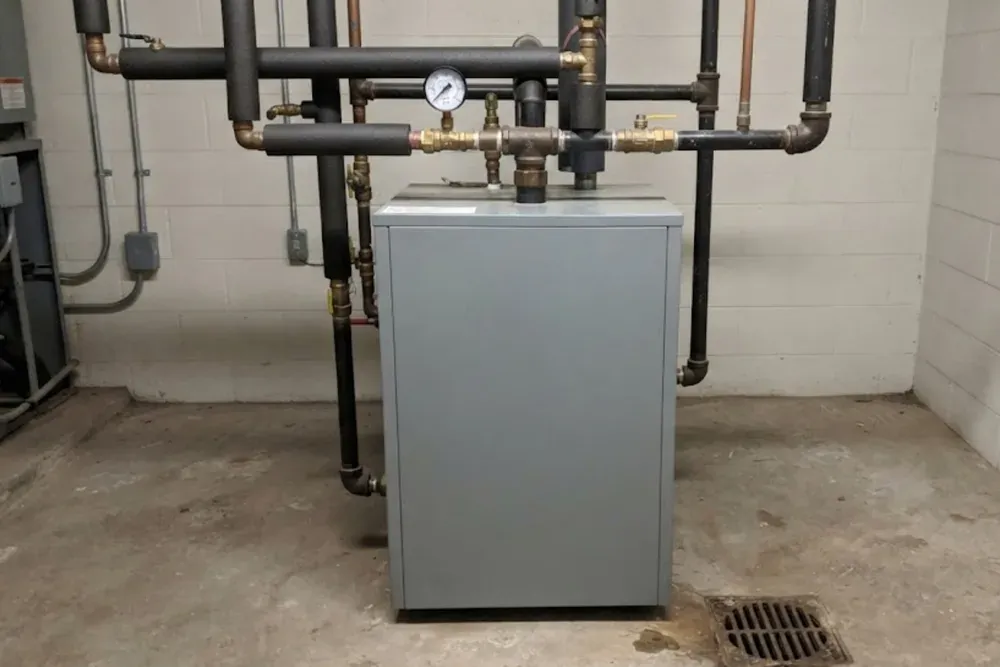
If your boiler quits on a cold night, you can check four things in a few minutes: the thermostat, the power switch and breaker, the pressure gauge, and whether the fuel supply is on. If none of those fix it, call a 24/7 boiler repair service rather than opening the boiler yourself.
If a carbon monoxide alarm sounds, leave the house and call 911 first. For a heating failure in Englewood, NJ, the other urgent worry is frozen pipes, so keep the house as warm as you can until help arrives.
Safety first: when to leave instead of troubleshoot
A carbon monoxide alarm means leave. Get everyone outside, including pets, and call 911 from outside. Do not reset the alarm and go back in.
A gas smell means the same thing. Leave the building and call the gas utility or 911. Do not flip switches, light anything, or look for the source. Water leaking from the boiler near electrical parts also calls for staying clear.
Five visible checks, in order
Set the thermostat to heat and raise it
Put it about five degrees above the room temperature. Replace the batteries if the display is blank or dim.
Check the boiler power switch and breaker
Most boilers have a wall switch that looks like a light switch near the unit. Make sure it is on, and check the breaker panel for a tripped breaker.
Read the pressure gauge
A typical home hot-water boiler sits somewhere around 12 to 15 psi when cold, though your manual has the number. A needle near zero suggests a leak or low fill. A needle in the red may mean a pressure problem.
Confirm the fuel supply
For oil, look at the tank gauge. For gas, check that other gas appliances work. Do not touch the gas line or adjust valves other than those the manual names.
Look at the display or lights
Many boilers show a code or a blinking light. Write down what you see. A technician can use it.
What you see and what it points to
This table connects each visible sign to a likely cause and a sensible next move.
| What you see | What it might mean | Next move |
|---|---|---|
| Thermostat blank | Dead batteries or lost power | Replace batteries, then check the breaker |
| Boiler silent, no lights | No power to the unit | Check the switch and breaker once. Do not keep resetting |
| Pressure near zero | Water loss from a leak or relief valve | Look for drips and call. Do not add water repeatedly |
| Pressure high or relief valve dripping | Expansion tank or fill problem | Call a licensed plumber |
| Boiler runs, radiators cold | Air in the system, a stuck pump, or a closed valve | Check radiator valves and call if still cold |
| Clicking or repeated start attempts | Ignition or flame sensing fault | Stop and call. Repeated tries do not help |
| Smell of fuel oil or gas | Fuel leak | Leave and call 911 or the gas utility |
Reset once at most. Repeated resets on a boiler can flood the burner or hide the fault.
Why a boiler quits when it is coldest
A boiler works hardest on the coldest nights, so weak parts tend to fail then. A worn ignitor, a dirty flame sensor, a failing circulator pump, or low water pressure may limp along in mild weather and give out when demand goes up.
Fuel is another reason. An oil tank that ran low, or a filter clogged with sludge, can stop the burner exactly when you need it. Gas supply interruptions are rarer, but a pilot or ignitor that fails will have the same effect.
None of this is a reason to panic. It is a reason to keep a service record, note the boiler's age and model, and schedule a tune-up before heating season rather than after the first cold snap.
Protect the pipes while you wait
When the heat stops, the real danger in a freezing house is the water in the pipes. Pipes in exterior walls, unheated garages, crawl spaces, and basements near the foundation freeze first. A frozen pipe can split, and the leak shows up when the ice thaws.
Open cabinet doors under sinks on exterior walls so room air can reach the pipes. Let a faucet at the far end of the house drip slowly. Use space heaters only if they are rated and plugged straight into a wall outlet, set on a hard floor, and away from anything that burns.
If a pipe does burst, shut off the main water valve right away and call for burst pipe repair. Stay out of any flooded area if water has reached outlets or electrical equipment.
What to tell the dispatcher
Clear information speeds up the call and helps the technician bring the right parts.
- Boiler brand, approximate age, and fuel type (oil or gas)
- What the display or lights show, and any code
- The pressure gauge reading
- What you have already checked, and whether you reset it
- Whether you have a carbon monoxide alarm and whether it is quiet
- Whether any pipes are cold, frozen, or leaking
What a licensed plumber does at 2 a.m.
A licensed technician starts with safety, checking for carbon monoxide, fuel leaks, and water near electrical parts. Then they check the controls, the ignition sequence, water pressure, the circulator, and the vent path.
Many failures are quick, such as a flame sensor cleaning or a thermostat wire. Others, such as a cracked heat exchanger or a failed circulator on an old system, may call for a part that is not on the truck. The tech can restore heat temporarily when it is safe, then plan the repair for daylight.
That is what 24/7 boiler repair is for. Ask for a clear price before work starts, and ask what is a safe temporary fix versus a final repair. Emergency dispatch also reaches Leonia and Fort Lee around the clock.
General cost ballparks for boiler problems
These are wide, rounded industry ballparks, labelled general, and after-hours calls often cost more.
| Job | General ballpark | Why it varies |
|---|---|---|
| Diagnostic visit and minor fix | Roughly $150 to $500 | After-hours rates and the part involved |
| Circulator pump or ignitor replacement | Roughly $400 to $1,200 | Brand, access, and whether the part is in stock |
| Boiler replacement | Roughly $5,000 to $12,000 or more | Size, fuel, venting, and piping changes |
If your boiler is old and repairs keep coming, a replacement quote is worth requesting.
What Englewood homeowners should know about heating and older housing
Englewood is a long-settled city. The Erie Railroad's Northern Branch started passenger service here in 1859, so a lot of the housing is older. That suggests heating systems vary widely from house to house, from newer equipment to boilers and piping that have been repaired for decades. Each house has to be checked on its own, so keep notes on yours.
If a boiler replacement is on the table, permit rules vary by job, so ask the Englewood Building & Code Enforcement office at 2-10 North Van Brunt Street before work begins. A licensed plumber should know the usual steps, but the city is the authority on what applies to your address.
Source type: City of Englewood history, Englewood Building & Code Enforcement contact page.
Check a plumber before you hire
New Jersey law says plumbing work must be done by a licensed master plumber. Ask for the licence number, then confirm it with the State Board of Examiners of Master Plumbers, part of the New Jersey Division of Consumer Affairs.
Permit rules vary by job, so ask the Englewood Building & Code Enforcement office before work begins.
Questions homeowners ask
A single reset is reasonable. Repeated resets can flood the combustion chamber, hide a real fault, or trip safety controls. If the boiler fails twice, stop and call.
Some boilers have a fill valve that homeowners are told to use, and the manual describes it. If pressure keeps dropping, there is a leak, and adding water repeatedly can hide it. Call for a check.
It depends on outdoor temperature, wind, insulation, and where the pipes run. Pipes in exterior walls and unheated spaces can freeze within hours in a hard freeze. Do not wait to see.
A boiler heats water and sends it to radiators, baseboards, or in-floor loops. A furnace heats air and pushes it through ducts. This page is about boilers.
Leonia runs from about 5 feet in the west to about 318 feet in the east, but elevation alone does not decide a heating problem. Wherever you live in the borough, check exterior walls, the pressure gauge, and unheated spaces for freeze risk.
Still not sure what you need? Call the line and describe what you see.
Call (551) 249-3045