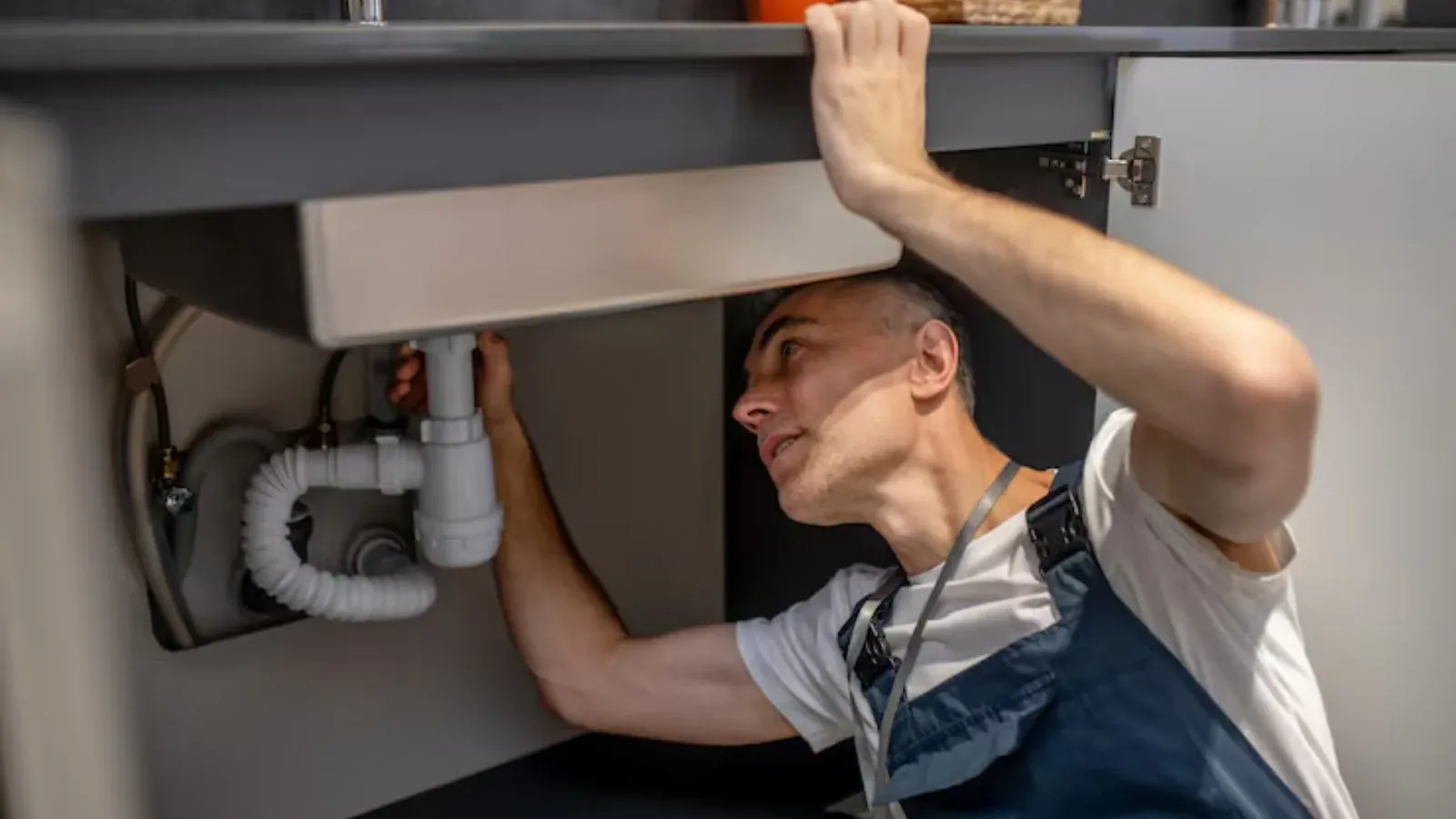
Kitchen faucet leak repair starts with finding where the water actually comes from. A drip at the spout usually means a worn cartridge or washer. Water around the handle or the base of the spout points to worn O-rings. Wet cabinet floors often come from supply lines, shutoff valves, or the drain, not the faucet itself.
In Englewood, NJ, most of these are manageable for a careful homeowner if the shutoff valves work. Shut the water off first, match the replacement part to the exact faucet, and stop if anything corrodes or won't turn. A faucet that is old, pitted, or leaking from the body is usually cheaper to replace than to chase.
Where the water shows up and what it usually means
Dry the area with a towel, run the faucet, and watch where the first bead of water appears.
| Where it leaks | Likely cause | Typical fix |
|---|---|---|
| Drip from the spout when the handle is off | Worn cartridge, washer, or valve seat | Replace the cartridge or washer and seat |
| Water around the handle base | Worn O-ring or loose packing nut | Replace O-rings or snug the nut |
| Water at the base of a swivel spout | Dried or cut spout O-rings | Replace the O-rings with matching ones |
| Wet under the sink, drips from the hose connections | Loose or failing supply lines | Tighten gently or replace the lines |
| Wet under the sink, only when the sprayer is used | Cracked sprayer hose or loose fitting | Replace the hose or reseat the fitting |
| Water drips from the shutoff valve stem | Worn valve packing | Replace the valve, a licensed plumber task |
If water appears from a crack in the metal body of the faucet, repair is rarely worth the effort.
Cartridge, washer, and disc faucets in plain words
Older compression faucets use rubber washers that press against a valve seat as you turn the handle. Over time the washer hardens and the seat roughens, and the faucet drips. These faucets usually have two handles.
Most single-handle faucets use a cartridge, a plastic or brass cylinder with rubber seals that moves with the handle. Others use a ceramic disc cartridge, which is very durable but can still leak if grit damages the discs. A few use a ball assembly with springs and seals.
The takeaway is that the part you need depends on the faucet type and brand. Take the old part to a supply store or read the model number off the faucet. A wrong cartridge can make a leak worse.
A safe order of operations before you touch anything
Shut off the water
Turn the small oval or round stop valves under the sink clockwise. If they won't move, shut off the main instead.
Plug the drain and open the faucet
A towel or stopper keeps small parts from falling into the drain, and opening the faucet releases pressure.
Photograph each layer
Take pictures as you remove the handle, cap, and retaining nut so reassembly is straightforward.
Replace the failed part
Swap in the exact cartridge, washer, or O-rings, and clean the valve seat with a cloth.
Reassemble and test slowly
Open the stops, run the water, and check every connection with a dry paper towel.
What a homeowner can safely do, and where to stop
Replacing a cartridge, O-rings, or a braided supply line is a reasonable first project. Tighten fittings by hand and then a quarter turn with a wrench. Over-tightening cracks plastic nuts and crushes rubber seals.
Stop when you meet corrosion that has fused parts together, a shutoff valve that won't close, or a nut that rounds off. Forcing them can snap a pipe inside the wall. A shutoff valve that drips when turned is also a sign that the valve should be replaced.
Never wrap tape or sealant around a leaking joint and call it done. A seep that is hidden under a cabinet floor can rot wood and grow mold for months. If you cannot find the source, a leak detection visit can trace where the water begins.
Signs it is time to replace rather than repair
A new faucet makes sense when several of these are true.
- The finish is peeling, pitted, or flaking at the base
- Parts for the model are no longer sold
- The faucet has been repaired more than once in a short time
- Water leaks from the body or the neck of the spout
- Low flow persists after cleaning the aerator
- The mounting hardware is loose or the sink deck is cracked
Why a small drip is worth fixing now
A faucet that drips once a second can waste thousands of gallons over a year. That affects the water bill, but the larger risk is the hidden damage. Water that runs down the back of the faucet or along the supply lines pools in the cabinet.
Particleboard cabinet floors swell quickly when they get wet. Ask yourself when the cabinet last looked dry and whether there is a stain or a musty smell. If there is, schedule a plumber who handles faucet repair and can check the connections underneath.
In the meantime, a small bowl under a slow drip is fine. A steady stream is not. Shut off the stop valve and call.
What Englewood and Bergen County homeowners should know about faucet leaks
Fort Lee has 19,861 housing units, and many high-rise buildings have gone up there since 1968, including Horizon Towers. In a condo or co-op, the shutoff valves under your sink may not cover the whole unit, and a building shutoff may control a riser serving several apartments. Before you start a repair, ask building management where the unit shutoff is and whether you must notify them for any plumbing work.
In Englewood Cliffs, corporate campuses and homes sit along the Palisades, so the age of the plumbing can vary from address to address. Under-sink supply lines are cheap and easy to age, so replacing them when you replace the faucet is sensible. Ask the plumber to check both the stops and the lines at every visit.
Source type: municipal census data, Veolia press release.
Check a plumber before you hire
New Jersey law says plumbing work must be done by a licensed master plumber. Ask for the licence number, then confirm it with the State Board of Examiners of Master Plumbers, part of the New Jersey Division of Consumer Affairs.
Permit rules vary by job, so ask the Englewood Building & Code Enforcement office before work begins.
Questions homeowners ask
That points to a worn part on the hot side, such as a cartridge or seat. Hot water wears seals faster. If you have two handles, replace the washer or cartridge on the hot side and test.
Tape belongs on tapered pipe threads. Many faucet connections seal with a rubber washer or cone, and tape does nothing there. Check the fitting type before wrapping anything.
Look for bulges, rust on the metal braid, white crust at the connection, or a wet spot on the cabinet floor. A line older than about ten years is a good candidate for replacement while the cabinet is open.
Ask building management which valve isolates your unit and whether the building staff needs advance notice. In a high-rise, shutting a riser off affects neighbors. Do not try to close a building valve on your own.
A slow drip is not, but a stream, a spray, or water running under the cabinet is. Close the stop valves under the sink or the main, and call a licensed plumber if you cannot stop it.
Still not sure what you need? Call the line and describe what you see.
Call (551) 249-3045