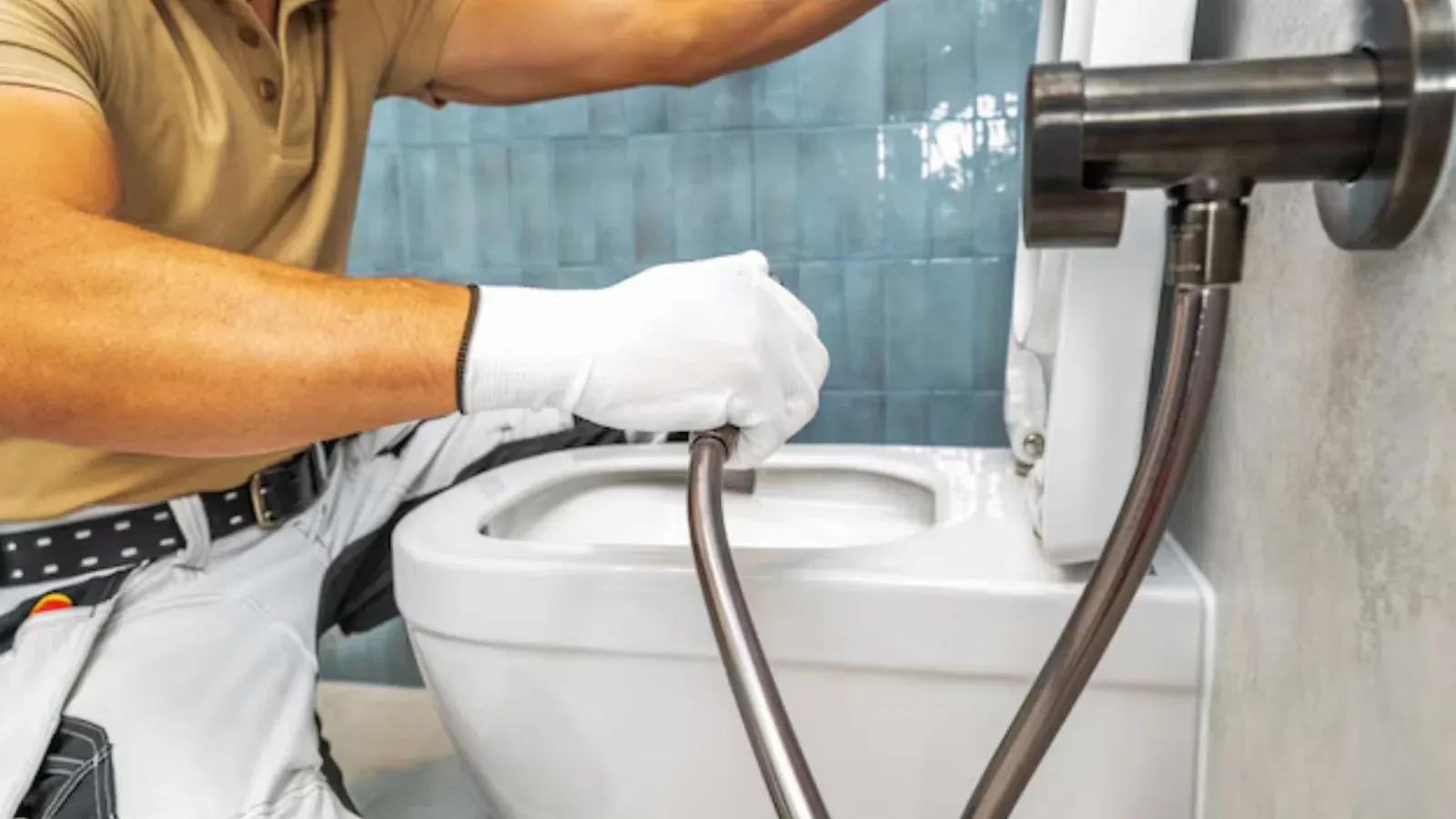
Most toilet parts are safe for a careful homeowner to replace. A fill valve, a flapper, and a supply line are all inside the tank or behind the toilet and take about half an hour each. A wax ring and closet bolts mean lifting the whole toilet, which is heavier and messier.
In Englewood, NJ, the real dividing line is what you see under the toilet. A rocking bowl, a soft floor, or a rusted flange is not a parts problem. That is where a licensed plumber should take over.
Which part fixes which problem
Match the symptom to the part before you shop.
| Symptom | Likely part | DIY level |
|---|---|---|
| Tank keeps refilling or hisses | Fill valve or flapper | Easy |
| Toilet runs on its own for a few seconds | Flapper or flapper seat | Easy |
| Water on floor near the wall | Supply line or stop valve | Moderate |
| Water at the base of the toilet | Wax ring, closet bolts, or flange | Harder |
| Rocking toilet | Loose bolts or a damaged flange | Check first, then decide |
| Water drips from tank bolts | Tank-to-bowl gasket or bolt washers | Moderate |
A flapper that leaks into the bowl is the most common culprit behind a toilet that runs.
Replacing the fill valve
Shut off water and empty the tank
Close the stop valve behind the toilet, flush, and sponge out the last water.
Disconnect the supply line
Loosen the nut under the tank and keep a towel handy for drips.
Remove the old valve
Unscrew the locknut under the tank and lift the valve out.
Set the new valve at the right height
Adjust it per the package so the top sits above the overflow tube.
Reconnect and set the water level
Open the stop slowly and adjust the float so the water stops about an inch below the top of the overflow tube.
The flapper and the chain
The flapper is the rubber seal at the bottom of the tank that lifts when you flush. A worn flapper warps and no longer seals, so tank water leaks into the bowl and the fill valve refills it. Replacement flappers snap onto pegs or clip onto the overflow tube.
Match the size. Many toilets use a 2-inch flapper, and newer ones often use 3-inch. A mismatch leaks. The chain should have just a little slack. Too tight and the flapper stays up, too loose and it won't lift.
If a new flapper still leaks, run a fingernail around the flapper seat. Mineral buildup or a nick there stops a good seal. A light cleaning may help, and a rough seat is a reason to call.
Supply line and stop valve
A braided stainless supply line, commonly 3/8 inch at the stop valve, connects the valve to the fill valve. Replace it if it's bulging, rusted, or kinked. Tighten by hand plus a quarter turn.
Old multi-turn stop valves can fail when you turn them. They may not shut off fully, or the stem may start to drip. That is a sign the valve needs replacing, which means shutting off the main and doing more plumbing work than a parts swap.
Do not force a stuck valve. A cracked valve behind a wall can flood a bathroom, and that is a fast way to turn a ten-minute job into an emergency.
Setting a toilet on a new wax ring
Shut off, drain, and disconnect
Empty the tank and bowl, disconnect the supply, and remove the nuts on the closet bolts.
Lift straight up
A toilet can weigh 60 to 100 pounds or more. Get a second person, and set it on a towel.
Scrape and inspect
Remove the old wax, then look at the flange for cracks, rust, or a poor fit to the floor.
Install new closet bolts and ring
Slide new bolts into the flange slots and press on a new wax ring or a rubber seal.
Lower, tighten gradually, and test
Press the bowl down level, tighten the nuts alternately, and don't overtighten the porcelain. Fill the tank and check the base after several flushes.
What signals a flange or floor problem
Stop and call a plumber if you find any of these.
- A flange that sits below the finished floor or is cracked
- Rust or corrosion on a cast iron flange
- Soft, spongy, or discolored flooring around the base
- A toilet that keeps rocking after new bolts
- Sewer smell even after a new wax ring
- Repeated leaks at the base after a reset
When a parts swap is the wrong plan
A toilet that has leaked at the base for months may have rotted the subfloor. Fixing the wax ring does not fix a soft floor. The floor may need repair before the toilet sits on it again.
Water stains on a ceiling below, black mold near the base, or a spongy feel under your foot are warning signs. They point to a larger leak than a seal can explain.
That is when toilet repair and installation by a licensed plumber is the safer choice, and new flange piping falls under plumbing installation. They can check the flange, repair or replace it, and set the toilet to the finished floor.
What Englewood and Bergen County homeowners should know about toilet repairs
New Jersey requires plumbing to be performed by a master plumber, and licences expire every two years on June 30 of odd-numbered years. Ask any plumber who works on your flange or floor for the licence number and confirm it with the State Board of Examiners of Master Plumbers. Replacing small parts like a flapper in your own home is a different matter from hiring someone to cut into floors and pipes.
Teaneck has about 41,246 residents, so flange heights and floor layers differ from house to house. Fort Lee has 19,861 housing units and many high-rise buildings, where a leak at the base can reach the apartment below. In those buildings, report any leak to management right away.
Source type: NJ Division of Consumer Affairs, municipal census data.
Check a plumber before you hire
New Jersey law says plumbing work must be done by a licensed master plumber. Ask for the licence number, then confirm it with the State Board of Examiners of Master Plumbers, part of the New Jersey Division of Consumer Affairs.
Permit rules vary by job, so ask the Englewood Building & Code Enforcement office before work begins.
Questions homeowners ask
No. Wax rings flatten and harden once a toilet sits on them, and the seal will not reform. A new ring is cheap compared to the cost of a leak. Replace it any time the toilet is lifted.
Snug them evenly until the toilet no longer rocks, then stop. Porcelain cracks under too much force. Alternating between the two sides keeps the bowl level.
Many plumbers caulk the front and sides but leave a gap at the back, so a leak shows rather than hiding. Caulk should not replace a proper seal. Ask the plumber what they recommend.
That depends on the lease and the cause. Report any leak to the landlord in writing promptly, and don't attempt structural repairs yourself. Water can damage the unit below.
Common causes are water pressure that is too high, a loose connection, or a valve that is set too high. Try adjusting the fill rate or ask a plumber to check the pressure.
Still not sure what you need? Call the line and describe what you see.
Call (551) 249-3045