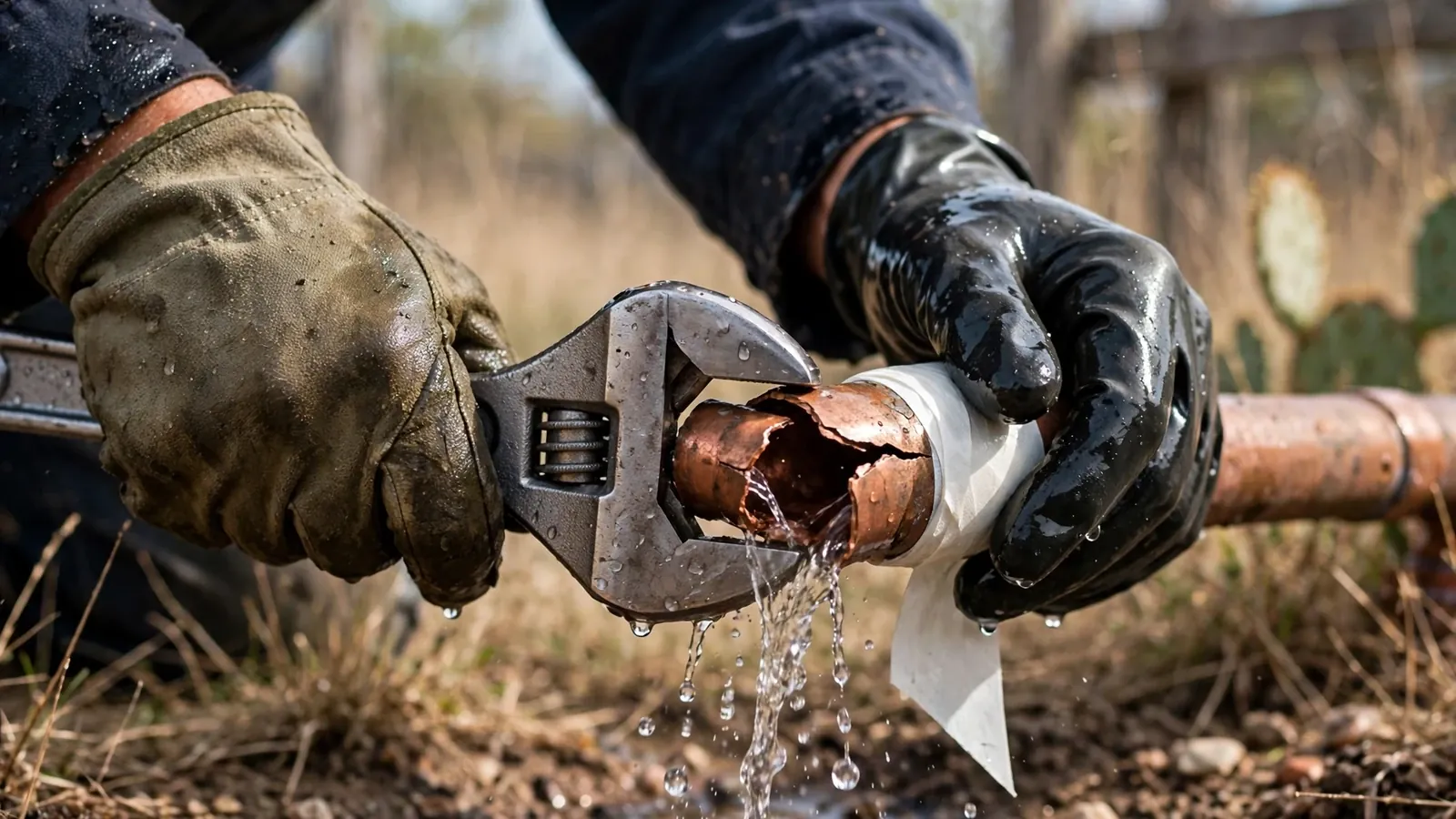
If a pipe freezes, open the nearest faucet, then warm the pipe slowly with a hair dryer or warm towels, working from the faucet toward the frozen spot. Never use an open flame, a torch, or a propane heater. If you see a crack, a bulge, or water leaking, shut off the main water valve and call a licensed plumber.
In Englewood, NJ, the pipes most at risk run through exterior walls, unheated garages, crawl spaces, and basements near the foundation. Acting early matters, since ice can split a pipe before you notice.
Thaw a frozen pipe safely
Find the frozen section
No water or a trickle from a faucet is the first sign. Feel pipes on exterior walls and in cold spaces for frost or a very cold section.
Open the faucet
Open the tap that the frozen pipe feeds, hot and cold. Water has to be able to flow out as the ice melts, and it relieves pressure.
Apply gentle heat
Use a hair dryer, a heating pad, or towels soaked in hot water. Start near the faucet and move toward the blockage.
Keep watching for leaks
As ice melts, a split can start to spray or drip. Be ready to close the main shutoff.
Keep the water running a bit
Once water flows, leave the tap open slightly for a while, then check other fixtures for ice.
What never to use
Do not use a torch, a lighter, a kerosene or propane heater, or any open flame on a pipe. Heat that is too fast and too local can boil the water trapped in the ice, crack the pipe, or ignite the framing and insulation behind it.
Do not use a hot electric heat gun on plastic pipe, and do not stand in water while using electric tools. If the area is wet, keep electrical devices out of it.
Where pipes freeze and what to do
Freezing follows cold air, not just cold weather. This table covers the usual trouble spots.
| Location | Why it freezes | Quick protection |
|---|---|---|
| Pipes in exterior walls | Little insulation and cold air against the wall cavity | Open the cabinet doors, let a faucet drip, add insulation |
| Unheated garage | No heat, and supply lines often run along the walls | Insulate the pipes, close the garage door, add heat tape rated for the pipe |
| Crawl space | Cold air moves under the floor, and vents let it in | Seal vents, insulate pipes, close access doors |
| Basement near the foundation | Cold air from windows and rim joists | Seal gaps, insulate the pipes, keep the basement above freezing |
| Outdoor hose bib | Water left in the line and spigot | Disconnect hoses and shut the interior valve |
| Water service line entering the house | Shallow or exposed sections near the foundation | Keep the entry area warm and call a plumber if flow stops |
Where one pipe froze, others likely came close. Check the whole run.
Shut off the water before a thaw turns into a flood
A frozen pipe is a plug of ice, and the ice itself often holds the crack closed. When the ice melts, water pours through the split. That is why many burst pipes are found after the thaw, not during the freeze.
Know where your main shutoff is before you need it. It is usually near where the water line enters the house, often in the basement, a utility room, or near the water meter. Turn it clockwise to close it, and test it once a year so it is not stuck.
If you see water or a visible crack, close the main valve, open the lowest faucet to drain the lines, and call for burst pipe repair. If water is near outlets, the panel, or appliances, stay out and shut off the power at the breaker only if you can reach it dry.
How a pipe bursts
Water expands when it freezes. The surprise is where the pipe breaks. Ice forms in one place, and as it grows it traps water between the ice and a closed faucet. That trapped water has nowhere to go, so pressure builds and the pipe splits, often some distance from the ice itself.
Copper, steel, and plastic pipe all can split, though plastic such as PEX tolerates freezing better than rigid copper. That does not mean it is safe. Fittings can still pull apart.
Small splits can run for hours before anyone notices. Check ceilings, walls, and the floor below any pipe that froze, and watch the water meter. If it moves while everything is off, water is leaking somewhere.
Prevent frozen pipes before the next cold snap
Most of these cost little and take an afternoon.
- Insulate exposed pipes in the basement, garage, and crawl space with foam sleeves
- Disconnect garden hoses and close the interior valve to outdoor spigots
- Seal air leaks around pipes where they pass through walls and rim joists
- Open cabinet doors under sinks on exterior walls during hard freezes
- Let a faucet drip slowly on the coldest nights
- Keep the thermostat set no lower than about 55 degrees Fahrenheit when away
- Know where your main shutoff valve is and make sure it turns
When the problem is outside the house
If no water comes out of any tap, the freeze may be in the service line between the street and the house. That is the pipe that brings water in, and it is buried below ground. If it is frozen or damaged, it needs a plumber's attention, since thawing it can involve special equipment.
Ask your water supplier who owns which part of the service line, since responsibility often divides at the curb or the meter. A leak on your side is yours to repair. A licensed plumber can look at water service line repair options if the line is damaged.
As a general industry ballpark, a burst pipe repair inside the house often runs roughly $250 to $1,000 for the plumbing, and water damage cleanup is a separate cost. Service line work can run into several thousand dollars, depending on length and digging. These are wide, rounded ballparks and not a quote.
Insurance and what to document
Homeowner's policies often cover sudden water damage from a burst pipe, while slow leaks and wear usually are not. Ask your carrier what applies to your policy.
Neighbors in Tenafly and Leonia deal with the same claim steps. Take photos or video of the damage before you clean up, keep receipts, and save the broken pipe section if you can. A plumber's written description of what failed helps with a claim.
What Tenafly, Leonia, and Englewood homeowners should know about freezing
Englewood has been settled for well over a century, and the Erie Railroad's Northern Branch started passenger service here in 1859. Older houses often have additions, porches, and pipes routed through places that were never planned for water lines. Each house has to be checked on its own, but pipes along the exterior walls of an older house are a good place to start.
Leonia ranges from about 5 feet in elevation in the west to about 318 feet in the east, and Tenafly's East Hill rises sharply toward the Palisades. A house on a slope can have basement walls partly exposed on one side, so a pipe near that wall may sit in colder air than the rest of the basement. Walk your own basement and note any cold corners.
Source type: City of Englewood history, Leonia and Tenafly borough census and elevation data.
Check a plumber before you hire
New Jersey law says plumbing work must be done by a licensed master plumber. Ask for the licence number, then confirm it with the State Board of Examiners of Master Plumbers, part of the New Jersey Division of Consumer Affairs.
Permit rules vary by job, so ask the Englewood Building & Code Enforcement office before work begins.
Questions homeowners ask
There is no single answer. Wind, insulation, and where the pipe runs matter more than the thermometer alone. Pipes in exterior walls and unheated spaces can freeze in hours during a hard cold snap.
On very cold nights, a slow drip at a faucet on an exterior wall can help, because moving water is harder to freeze and relieves pressure. It uses a little water, which is cheaper than a burst.
Not necessarily, but each freeze is a risk. A pipe that froze once should be inspected and insulated. Check for leaks after any thaw.
A space heater can warm the room, but keep it away from anything flammable and never leave it unattended. Do not aim it at wet areas. Hair dryers and warm towels are safer for direct thawing.
Slope itself does not freeze pipes, but exposure does. Slope alone does not freeze pipes. Exposed walls, drafts, and unheated spaces do, at any elevation. Walk your own basement and check the pipes along walls that face outside first.
Still not sure what you need? Call the line and describe what you see.
Call (551) 249-3045