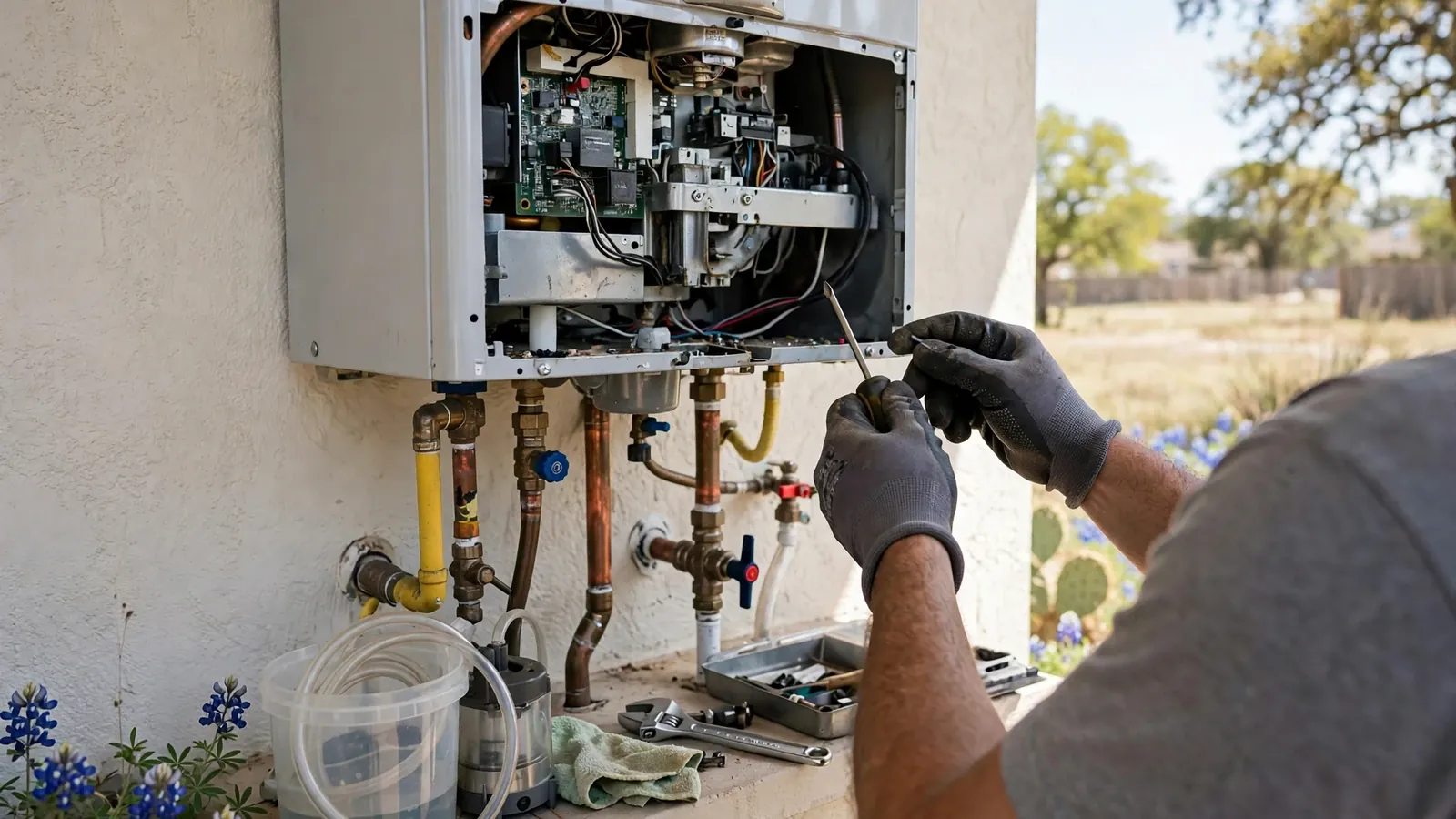
Most tankless water heater problems come from a short list: scale on the heat exchanger, clogged inlet screens, a low flow rate, a gas or power interruption, or a venting fault that triggers an error code. You can safely check the display code, the shutoff valves, the screens, and whether other fixtures run hot.
Anything that involves gas lines, venting, or the inside of the unit belongs to a licensed plumber, whether the job is a water heater repair or a full tankless water heater service. In Englewood, NJ, a unit that shows an error code, produces no hot water, or smells like gas should be shut off and looked at professionally.
Symptom, likely cause, and who handles it
Use this as a starting map. The right fix depends on the brand and model, so your manual comes first.
| Symptom | Common cause | What you can do |
|---|---|---|
| No hot water at all, display dark | Power outage, tripped breaker, or loose cord | Check the outlet and the breaker. Call if power is fine |
| Display shows an error code | Ignition, flame, venting, sensor, or flow fault | Look up the code in the manual. Reset once if the manual allows |
| Water runs lukewarm or fluctuates | Scale, low flow, or too many fixtures running at once | Close other taps and retest. Ask about descaling |
| Hot water fades in a shower after a minute | Flow too low to fire the burner, or clogged filter | Clean the inlet screen if it is accessible |
| Burst of cold water between uses | The cold-water sandwich, a normal effect | Wait a few seconds. Ask about recirculation options |
| Smell of gas or exhaust | Gas leak or venting failure | Leave the house and call the gas utility or 911 |
Gas smell is not a troubleshooting step. Leave first and call from outside.
Start with the display and the manual
Modern tankless units show a code when they detect a fault. The codes differ between brands, and the same number can mean different things on different models. Look up your code in the owner's manual or on the manufacturer's support page, not in a general list online.
Most manuals describe a reset step, usually turning the unit off and back on, or pressing a reset button. Try it once. If the same code returns, the unit is telling you something is actually wrong, and repeated resets will not fix a real fault.
Write the model number, the code, and what happened right before it. That information helps a technician bring the right parts, and it saves time on the phone.
The cold-water sandwich is not always a fault
If you shower, turn the water off briefly, and then turn it back on, you may get a short blast of cold. That is the cold-water sandwich. Water left sitting in the pipe cools off, and when you reopen the tap that cold slug reaches you before the heater has caught up.
Homeowners in Teaneck and Tenafly ask about this a lot. A small gap of cold water is normal with a tankless unit, and no repair will remove it. What helps is a recirculation pump or a small buffer tank, which keep hot water moving or stored near the fixtures. Ask a licensed plumber whether your unit supports that setup.
A long cold stretch, or hot water that never returns, is different. That points to a minimum flow problem, a clogged filter, or a fault, and it is worth a proper look.
Safe checks you can do yourself
Confirm power and fuel are on
Check the breaker or outlet for an electric unit. For gas, confirm the appliance gas valve is open and other gas appliances work.
Test other fixtures
If only one faucet is the problem, the fixture or its aerator may be clogged, not the heater.
Check the inlet water filter
Many units have a small screen where cold water enters. Close the isolation valves, release pressure per the manual, remove it, rinse it, and put it back.
Look at the vent termination outside
Make sure leaves, snow, or a nest are not blocking the exhaust or intake. Do not touch the flue pipe joints.
Note the code and try a single reset
Follow the manual. If the code comes back, stop and call.
Scale and flushing: the maintenance that matters most
Minerals in water build up as scale on the heat exchanger, the part that transfers heat from the burner to the water. Scale insulates the metal, so the unit works harder, flow drops, and error codes become more frequent. Over time it can shorten the life of the heater.
Manufacturers commonly recommend flushing the unit with a descaling solution on a regular schedule, often about once a year, though the right interval depends on your water and the model. The job uses a small pump, hoses, and a food-safe descaling liquid circulated through the unit through service valves.
If the unit has service valves, a plumber can flush it quickly. If it does not, adding them during the first visit makes every later flush easier. Skipping the flush is the single most common reason a tankless heater fails earlier than expected.
Leave these to a licensed plumber
These problems involve gas, combustion, or the sealed inside of the unit.
- Any smell of gas, or a suspected gas leak
- Soot, scorch marks, or a sharp exhaust smell near the unit
- Repeated ignition or flame-failure codes after a reset
- Water leaking from inside the cabinet
- Venting that looks loose, disconnected, or corroded
- A carbon monoxide alarm sounding
Carbon monoxide alarm: leave first
If a carbon monoxide alarm goes off, get everyone out of the house, including pets, and call 911 from outside. Do not stop to investigate the heater.
Fuel-burning appliances with poor venting are a classic source. Do not use the water heater again until a licensed professional has found the cause.
Repair or replace: rough cost ballparks
These are wide, rounded industry ballparks, labelled general. Your quote depends on brand, parts, and access.
| Job | General ballpark | Notes |
|---|---|---|
| Service call and diagnosis | Roughly $100 to $300 | Often credited toward a repair, so ask |
| Descaling flush | Roughly $150 to $400 | Faster if service valves already exist |
| Part replacement such as a sensor or igniter | Roughly $200 to $700 | Depends on the part and the brand |
| Full unit replacement | Roughly $2,500 to $5,500 | Venting, gas line size, and fittings change the number |
If the unit is well past ten years old and needs a major part, replacement may make more sense. Ask the plumber to explain both options with a clear price before work starts.
Water supply and scale: what Bergen County homeowners should know
Much of northern Bergen County drinks water from Veolia's Oradell Reservoir system, so check the supplier named on your water bill, and ask that supplier for its annual water quality report. That report is the right place to learn about your water, because scale depends on what is in it.
Veolia's system treats reservoir water at the Haworth Water Treatment Plant, and more than 885,000 residents and businesses in Bergen and Hudson counties depend on the system. Water quality varies by supplier, so do not assume your tap matches a neighbor's. If your supplier's report shows mineral content that concerns you, ask the plumber about a descaling schedule or a sediment filter ahead of the heater.
Source type: Veolia press release, September 20, 2023, Veolia North America.
Check a plumber before you hire
New Jersey law says plumbing work must be done by a licensed master plumber. Ask for the licence number, then confirm it with the State Board of Examiners of Master Plumbers, part of the New Jersey Division of Consumer Affairs.
Permit rules vary by job, so ask the Englewood Building & Code Enforcement office before work begins.
Questions homeowners ask
The unit may not see enough flow to keep the burner lit, or a screen or aerator is clogged. It may also be tripping on a venting or temperature sensor. Clear the screens, then call if it keeps happening.
Many manuals describe using white vinegar or a descaling solution through the service valves. That needs the right pump, hoses, and a way to avoid cross-connecting. If you are not sure, have a plumber do the first flush.
Usually not. It is a side effect of how on-demand heating works. A recirculation line or a small buffer tank can shorten it, but they add cost and are not right for every setup.
Many manufacturers suggest yearly service, with flushing frequency based on your water. Follow your manual, since warranty terms sometimes depend on documented maintenance.
Look at your water bill for the supplier name and a customer service number. Ask them for the latest annual water quality report. Do not assume a neighboring town has the same supplier.
Still not sure what you need? Call the line and describe what you see.
Call (551) 249-3045